
3 Process approach
3.1 Process
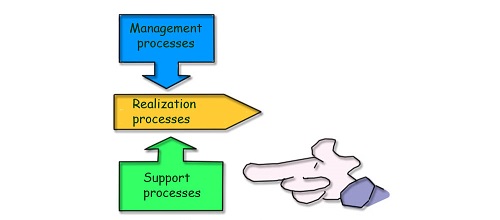
Process types, management, realization and support processes
If you cannot describe what you are doing as a process, you do not know what you're doing. Edwards Deming
The word processactivities that transform inputs into outputs (see also ISO 9000, 3.4.1) comes from the Latin root procedere = go, development, progress (Pro = forward, cedere = go). Each processactivities that transform inputs into outputs (see also ISO 9000, 3.4.1) transforms inputs into outputs, creating added value and potential nuisances.
A processactivities that transform inputs into outputs (see also ISO 9000, 3.4.1) has three basic elements: inputs, activities, outputs. .jpg)
A processactivities that transform inputs into outputs (see also ISO 9000, 3.4.1) can be very complex (launch a rocket) or relatively simple (audit a productany outcome of a process or activity (see also ISO 9000, 3.4.2)). A processactivities that transform inputs into outputs (see also ISO 9000, 3.4.1) is:
- repeatable
- foreseeable
- measurable
- definable
- dependent on its context
- responsible for its external providers
A processactivities that transform inputs into outputs (see also ISO 9000, 3.4.1) is determined, among others, by its:
- title and type
- purpose (why?)
- beneficiary (for whom?)
- scope and activities
- initiators
- documentation
- inputs
- outputs (intentional and not intentional)
- restraints
- people
- material resources
- objectives and indicators
- person in charge (owner) and actors (participants)
- means of inspection (monitoring, measurement)
- mapping
- interaction with other processes
- risks and potential deviations
- opportunities for continual improvement
A processactivities that transform inputs into outputs (see also ISO 9000, 3.4.1) review is conducted periodically by the processactivities that transform inputs into outputs (see also ISO 9000, 3.4.1) owner (cf. annex 02). 
Review: a survey of a file, product or process so as to verify if pre-set objectives are achieved
The components of a process are shown in figure 3-1:
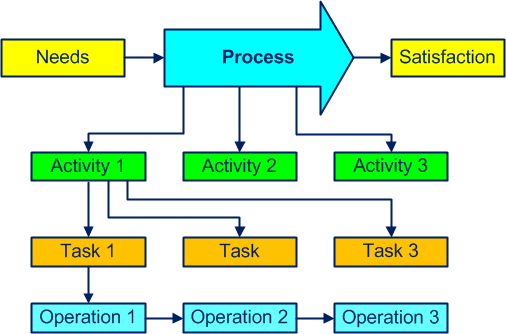
Figure 3-1. Components of a process
Figure 3-2 shows an example that helps to answer some questions:
- which materials, which documents, which tooling? (inputs)
- which title, what objective, which activities, requirements, constraints? (process)
- which products, which documents? (outputs)
- how, which inspections? (methods)
- what is the level of performance? (indicators)
- who, with what competence? (people)
- with what, which machines, which equipment? (material resources)
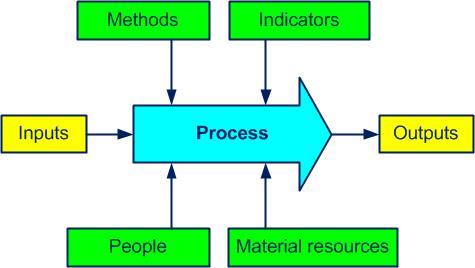
Figure 3-2. Some elements of a process
Often the output of a processactivities that transform inputs into outputs (see also ISO 9000, 3.4.1) is the input of the next processactivities that transform inputs into outputs (see also ISO 9000, 3.4.1).
Any organizationa structure that satisfies a need (see also ISO 9000, 3.2.1) (company) can be considered as a macro processactivities that transform inputs into outputs (see also ISO 9000, 3.4.1), with its purpose, its inputs (customeranyone who receives a product (see also ISO 9000, 3.2.4) needs and expectations) and its outputs (products/services to meet customeranyone who receives a product (see also ISO 9000, 3.2.4) requirementsexplicit or implicit need or expectation (see also ISO 9000, 3.6.4)).
Our preference is to identify a processactivities that transform inputs into outputs (see also ISO 9000, 3.4.1) using a verb (buy, produce, sell) instead of a noun (purchases, production, sales) to differentiate the processactivities that transform inputs into outputs (see also ISO 9000, 3.4.1) of the company's department or proceduredocument describing the to carry out a process (see also ISO 9000, 3.4.5 and documented information) and recall the purpose of the processactivities that transform inputs into outputs (see also ISO 9000, 3.4.1).
The processesactivities that transform inputs into outputs (see also ISO 9000, 3.4.1) are (as we shall see in the following paragraphs) of management, realization and support type. Do not attach too much importance to processactivities that transform inputs into outputs (see also ISO 9000, 3.4.1) categorizing (sometimes it's very relative) but ensure that all the company's activities fall at least into one processactivities that transform inputs into outputs (see also ISO 9000, 3.4.1).
3.1.1 Management processes
The following processes can be part of this family (* mandatory):
- assess risks*
- treat risks*
- assess the impact*
- report concerns*
- communicate
- conduct an audit
- plan the AIMS
- establish process ownership
- develop strategy
- establish policy
- deploy objectives
- conduct management review
- improve*
3.1.2 Realization processes
They are mainly (* mandatory):
- design and develop*
- use the AI system responsibly*
- manage operational requirements*
- ensure responsible supplier practices*
- record the provenance of the data*
- control outsourced processes
- manage incidents
- manage configuration
- test
- manage business continuity
- manage changes
- inspect
- implement security
- purchase
- maintain equipment
- control nonconformities
- implement corrective actions
3.1.3 Support processes
The support processes are often:
- maintain regulatory watch
- manage the employment contract
- apply discipline
- acquire and maintain infrastructure
- manage inspection means
- provide training
- provide information
- control documentation
3.2 Process mapping
Process mapping and house
Par excellence processactivities that transform inputs into outputs (see also ISO 9000, 3.4.1) mapping is a multidisciplinary work. This is not a formal requirementexplicit or implicit need or expectation (see also ISO 9000, 3.6.4) of the ISO 42001 standard but is always welcome.
The three types of processesactivities that transform inputs into outputs (see also ISO 9000, 3.4.1) and some interactions are shown in figure 3-3:
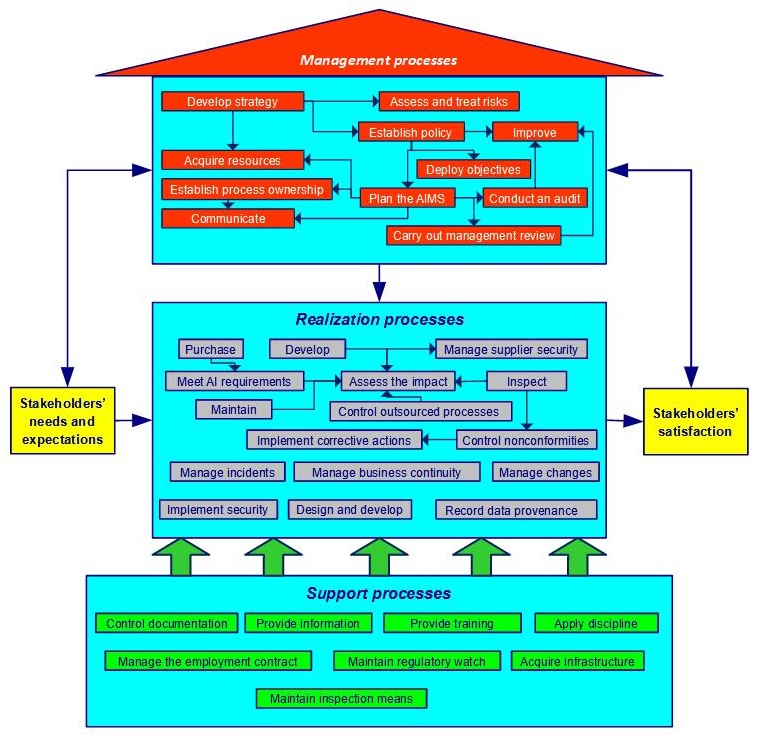
Figure 3-3. Process house
In the outputs, do not underestimate unwanted productsany outcome of a process or activity (see also ISO 9000, 3.7.6) such as rubbish, pollution and rejects.
Mapping, among other things, allows you to:
- obtain a global vision of the company
- identify the beneficiaries (customers), flow and interactions
- define rules (simple) for communication between processes
- develop strategy
- establish policy
- assess risks
- treat risks
- plan the AIMS
- deploy objectives
- establish process ownership
- improve
An example of the "design" process is shown in figure 3-4:
.jpg)
Figure 3-4. Design process
.jpg) Minute of relaxation. Game: Process
Minute of relaxation. Game: Process
3.3 Process approach
Process approach and continual improvement

Simple solutions for now, perfection for later
Process approach: management by the processes to better satisfy customers, improve the effectiveness of all processes and increase global efficiency
The process approachmanagement by the processes to better satisfy customers, improve the effectiveness of all processes and increase global efficiency (see also ISO 9001, 03) contributes enormously to the efficient management of the company (cf. annex 04).
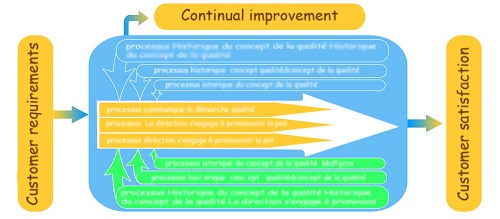
When the process approachmanagement by the processes to better satisfy customers, improve the effectiveness of all processes and increase global efficiency (see also ISO 9001, 03) is integrated during the development, implementation and continual improvementprocess allowing the improvement of the global performance of the organization (see also ISO 9000, 3.3.2) of an information securitycontrols to protect the confidentiality, integrity and availability of information (see also ISO 27000, 3.28) management systemset of processes allowing objectives to be achieved (see also ISO 9000, 3.5.3), it allows one to achieve objectives that are related to customer satisfactiontop priority objective of every management system (see also ISO 9000, 3.9.2), as is shown in figure 3-5.
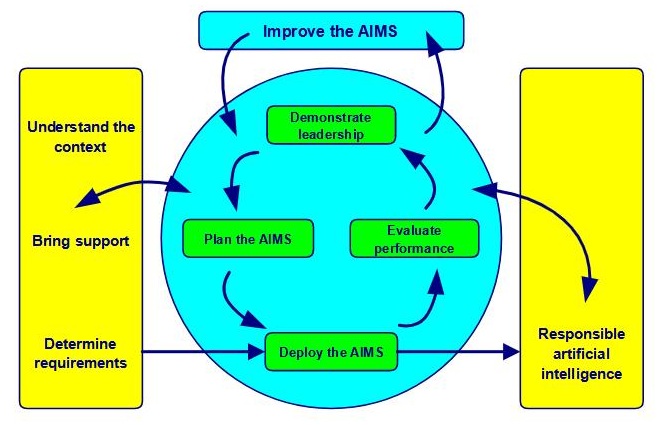
Figure 3-5. Model of an AIMS based on process approach and continual improvement
- emphasizes the importance of:
- understanding and complying with customer requirements
- prevention so as to react to unwanted elements such as:
- customer returns
- waste
- measuring process performance, effectiveness and efficiency
- permanently improving objectives based on pertinent measurements
- process added value
- relies on:
- methodical identification
- interactions
- the sequence and
- process management, which consists of:
- determining objectives and their indicators
- piloting related activities
- analyzing obtained results
- permanently undertaking improvement
- allows one to:
- better view inputs and outputs and their relationship
- clarify roles and responsibilities
- judiciously assign necessary resources
- break down the barriers between departments
- decrease costs, delays and waste
- and ensures in the long run:
- control
- monitoring and
- continual improvement of processes
- crisis management ("You will not solve the problems by addressing the effects")
- blaming people ("Poor quality is the result of poor management." Masaaki Imai)
- prioritizing investments ("Use your brain, not your money." Taiichi Ohno)
 Minute of relaxation. Paganini's violin concert performed with facial expressions.