
2 Definitions, standards and books
2.1 Definitions
Definitions and acronyms regarding an MBL management system

The beginning of wisdom is the definition of terms. Attributed to Socrates
Some definitions and acronyms:
Accreditation: attestation issued by a third party constituting formal recognition of competence to perform specific activities
ADR: Agreement concerning the International Carriage of Dangerous Goods by Road
AFNOR: French Standardization Association
Analyte: substance or chemical product that is the subject of an examination procedure
ANSM: French National Agency for the Safety of Medicines and Health Products
Audit: methodical and independent examination to determine whether activities and results meet pre-established provisions and are capable of achieving objectives
Benchmarking: comparative analysis technique vis-à-vis one or more competitors
Business continuity management: method aimed at ensuring that, in the event of a crisis, critical functions remain operational or are restored as quickly as possible (see also resilience)
Business Continuity Plan (BCP): planning for business continuity management, including the approach, stages, methods and resources
COFRAC: French Accreditation Committee
Competence: personal aptitudes, knowledge and experience
Complaint: expression of dissatisfaction made to a laboratory
Conformity: fulfillment of a specified requirement
COQ: Costs of Obtaining Quality
Corrective action: action to eliminate the causes of nonconformity or any other undesirable event and prevent their recurrence
CSF: cerebrospinal fluid
Effectiveness: ability to carry out planned activities with minimum effort
Efficiency: financial ratio between the result obtained and the resources used
EFQM: European Foundation for Quality Management
EFS: French Blood Establishment
EPS: Public health institution (France)
External Quality Assessment (EQA): performance relative to criteria based on interlaboratory comparisons
FIFO: first in, first out
FMEA: Failure Mode, Effects and Criticality Analysis
GDPR: General Data Protection Regulation
GLP: Good Laboratory Practice
HIV: Human Immunodeficiency Virus
IEC: International Electrotechnical Commission
Impartiality: absence of bias and absence of conflict of interest
Inspection: actions involving measurement, testing and examination of a product, service, process, or equipment to determine conformity with requirements
Internal Quality Control (IQC): activities to verify and validate the reliability of results
ISO: International Organization for Standardization
Kaizen: from the Japanese *kai* (change) and *zen* (better). Continuous, step-by-step improvement to create more value and less waste. Approach based on common sense and staff motivation
KPI: Key Performance Indicator
MBL: medical biology laboratory
LIS: Laboratory Information System
LNE: National Metrology and Testing Laboratory (France)
Management System (MS): set of processes enabling objectives to be achieved
MCT: multiple-choice test
Measurand: specific physical, chemical, or biological quantity subjected to a measurement process
Measurement uncertainty (MU): dispersion of the values attributed to a measurand
Medical device (MD): product or service used for the diagnosis, prevention, monitoring, treatment, or alleviation of a disease or injury
Medical laboratory: entity responsible for analyzing sample related to a disease or health condition
MPE: Maximum Permissible Error
MS: Management System
Nonconformity: failure to meet a specified requirement
OBP: Online Browsing Platform
Patient: person from whom the sample is obtained
PCR: Polymerase Chain Reaction
PDCA: Plan, Do, Check, Act
Performance: measurable and expected results of a management system
POCT: Point-of-Care Testing
Poor quality: gap between expected quality and perceived quality
PPE: Personal Protective Equipment
Procedure: document describing the actions to be taken to carry out a process
Process: activities that transform inputs into outputs
Quality indicator: value of a parameter, linked to an objective, allowing for the objective measurement of effectiveness
RACI: Responsible, Accountable, Consulted, Informed
Record: document providing tangible evidence of results obtained
Reference interval: distribution of values within a population
Requirement: implicit or explicit need or expectation
Resilience: ability to resolve a crisis and continue functioning as before
Responsibility: ability to make a decision independently
Risk: likelihood of a threat or opportunity occurring
Safety: absence of unacceptable risk
SMART: Specific, Measurable, Achievable, Realistic, Time-bound
Sample: portion of biological origin for examination
Strategy: overall approach to achieving objectives
SWOT: Strengths, Weaknesses, Opportunities, Threats
System: set of interacting processes
Threat: uncertain event that could have a negative impact on objectives
UPS: Uninterruptible Power Supply
User: person or entity utilizing the services of the medical laboratory
Validation: confirmation that the application of a process, product, service, or piece of equipment achieves the expected results
Verification: actions involving measurement, testing and examination of a product, service, process, or piece of equipment to determine compliance with requirements
Waste: anything that adds cost but no value
In the terminology of quality management systemsset of processes allowing the achievement of the quality objectives (see also ISO 9000, 3.5.4), do not confuse:
- accident and incident
- an accident is an unexpected serious event
- an incident is an event that can lead to an accident
- anomaly, defect, dysfunction, failure, nonconformity, reject and waste:
- anomaly is a deviation from what is expected
- defect is the non-fulfillment of a requirement related to an intended use
- dysfunction is a degraded function that can lead to a failure
- failure is when a function has become unfit
- nonconformity is the non-fulfillment of a requirement in production
- reject is a nonconforming product that will be destroyed
- waste is when there are added costs but no value
- audit program and plan
- an audit program is the annual planning of the audits
- an audit plan is the description of the audit activities
- audit, inspection, auditee and auditor
- an audit is the process of obtaining audit evidence
- an inspection is the conformity verification of a process or product
- an auditee is the one who is audited
- an auditor is the one who conducts the audit
- cause and symptom
- the cause is the circumstance leading to a failure
- the symptom is the characteristic associated with a state
- control and optimize
- control is meeting the objectives
- optimize is searching for the best possible results
- customer, supplier and subcontractor
- a customer receives a product
- a supplier provides a product
- a subcontractor provides a service or product on which specific work is done
- effectiveness and efficiency
- effectiveness is the level of achievement of planned results
- efficiency is the ratio between results and resources
- follow-up and review
- follow-up is the verification of the obtained results of an action
- review is the analysis of the effectiveness in achieving objectives
- inform and communicate
- to inform is to give someone meaningful data
- to communicate is to pass on a message, to listen to the reaction and discuss
- objective and indicator
- an objective is a sought after commitment
- an indicator is the information on the difference between the pre-set objective and the achieved result
- organization and enterprise, society, company
- organization is the term used by the ISO 9001 standard as the entity between the supplier and the customer
- an enterprise, society and company are examples of organizations
- prevention and protection, see figure 2-1
- prevention refers to measures that reduce the likelihood and frequency of a risk occurring (e.g., checking tire pressure)
- protection refers to measures that limit the impact of a risk (e.g., fastening one's seatbelt)
- probability, uncertainty and likelihood
- probability represents the quantitative analysis of uncertainty
- uncertainty is the imprecision involved in making predictions
- likelihood represents the qualitative analysis of uncertainty
- process, procedure, product, activity and task
- a process is how we satisfy the customer using people to achieve the objectives
- a procedure is the description of how we should conform to the rules
- a product is the result of a process
- an activity is a set of tasks
- a task is a sequence of simple operations
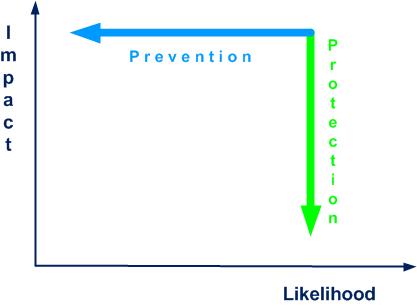
Figure 2-1. Prevention and protection
Note 1: Between "likelihood" and "probability," we prefer "likelihood" (of occurrence).
Note 2: Whenever you use the expression "opportunity for improvement" instead of "nonconformity," "malfunction," or "failure," you will further gain the trust of the person you are speaking with (patient or user).
Note 3: the use of ISO 9000 and ISO 15189 definitions is recommended.
The most important thing is to determine a common and unequivocal vocabulary for everyone in the company.
For other definitions, comments, explanations and interpretations not found in this module or in annex 06 (Glossary), you may consult: 

• ISO Online Browsing Platform (OBP)
• IEC Electropedia
2.2 Standards
Standards regarding MBL management systems

There can be no improvements where there are no standards. Masaaki Imai
Standards related to medical biology laboratory (MBLmedical biology laboratory) activitiesset of tasks to obtain a deliverable, in chronological order:
- BP Z74-700 (2011): Business Continuity Plan (BCP)
- CLSI GP36-A (2014): Planning for Laboratory Operations During a Disaster
- ISO 13485 (2016): Medical devices – Quality management systems – Requirements for regulatory purposes
- ISO/IEC 17025 (2017): General requirements for the competence of testing and calibration laboratories
- ISO 31000 (2018): Risk management – Guidelines
- ISO 14971 (2019): Medical devices – Application of risk management to medical devices
- ISO/TS 20914 (2019): Medical laboratories — Practical guidance for the estimation of measurement uncertainty
- ISO 35001 (2019): Biorisk management for laboratories and other related organisations
- IEC 31010 (2019): Risk management – Risk assessment techniques
- ISO 15190 (2020): Medical laboratories — Requirements for safety
- ISO/TR 24971 (2020): Medical devices — Guidance on the application of ISO 14971
- XP S99-223 (2020): Medical devices – Benefit-risk ratio management
- ISO 27001 (2022): Information security, cybersecurity and privacy protection — Information security management systems — Requirements
- SH REF 02 - Revision 08 (2023): Requirements for accreditation according to standard NF EN ISO 15189:2022, COFRAC
- ISO 20658 (2023): Requirements for the collection and transport of samples for medical laboratory examination purposes
- SH GTA 04 (2023): Technical accreditation guide for the verification (scope A) / validation (scope B) of medical biology methods
- ISO/IEC 17043 (2023): Conformity assessment — General requirements for the competence of proficiency testing providers
- ISO/TS 22583 (2024): Requirements and recommendations for supervisors and operators of point-of-care testing (POCT) equipment
- ISO 19011 (2026): Guidelines for auditing management systems
- ISO 9000 (2026): Quality management — Fundamentals and vocabulary
- ISO 15194 (2026): In vitro diagnostic medical devices — Requirements for certified reference materials and the content of supporting documentation
- ISO 22367 (2026): Medical laboratories — Application of risk management to medical laboratories
- ISO 9001 (2026): Quality management systems – Requirements
None of these standards is mandatory, but as Deming said:
There is no need to change. Survival is not mandatory
2.3 Books
Books regarding MBL management systems

Books for further reading, in chronological order:
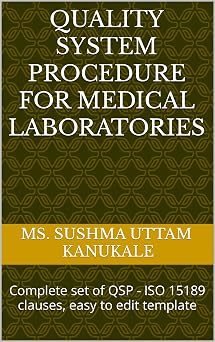 Sushma Uttam Kanukale, Quality System Procedure for medical laboratories: Complete set of QSP - ISO 15189 clauses, easy to edit template, Independently published, 2022
 Gerardus Blokdyk, The Operational Excellence Library; Mastering ISO 15189, 5STARCooks, 2024
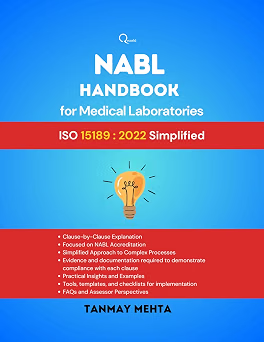 Tanmay Mehta, NABL Handbook for Medical Laboratories: ISO 15189:2022 Simplified, Q world, 2025
 Thierry Gatines, Sucessful iso 15189 certification, Thebookedition, 2025
 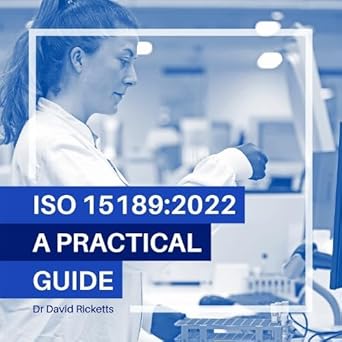 David Ricketts, ISO 15189:2022 - A Practical Guide, Independently published, 2026
 David Hensley, ISO 15189 Explained in Plain English: What the Medical Laboratory Quality and Competence Standard Actually Requires, Independently Published, 2026
When I think of all the books still left for me to rread, I am certain of further happiness. Jules Renard