


News on the standard ISO 9001 version 2026: quality management systems - requirements
09/05/2026
The sixth edition of ISO 9001 is scheduled for publication in September 2026.
According to the FDIS 9001 version 2026, the changes to the standard have almost no impact on the requirements and are mainly limited to clarifications. A large number of "almost" requirements are contained in the Notes.
The pillars of the ISO 9001 standard remain:
- the process approach
- customer focus
- the PDCA cycle
- the risk approach
- continual improvement
The requirements of the ISO 9001:2026 standard coming soon
The "ISO 9001:2026 requirements" quiz coming soon
The T 15v26 ISO 9001:2026 Readiness training course and its free demo (no registration required) coming soon
The T 35v26 ISO 9001:2026 Internal audit training course and its free demo (no registration required) coming soon
The T 75v26 ISO 9001:2026 Readiness and Internal audit training package coming soon
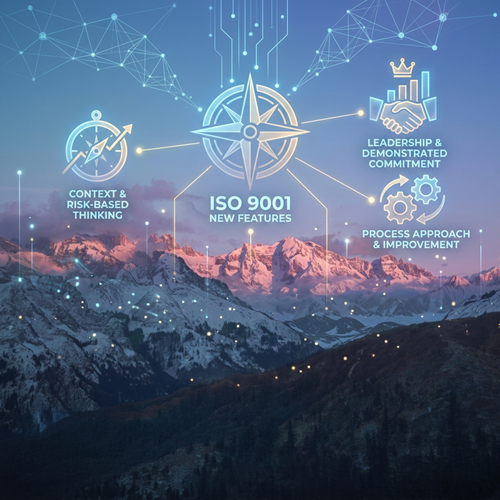
Some new features of the 2026 version:
- better consideration of the climate context
- strengthened leadership (quality culture and ethical behavior)
- more structured risk and opportunity management
- quality policy more aligned with strategy
- enhanced customer satisfaction Client
Details of New Features
- Clause 4
- the analysis of the company's context includes climate change
- a note specifies that relevant stakeholders may have requirements related to climate change
- Clause 5
- top management must now actively promote a quality culture and ethical behavior (demonstrate leadership)
- someone must report to top management on opportunities for improvement
- Clause 6
- risks and opportunities each have a dedicated sub-clause (6.1.2 and 6.1.3)
- opportunities are proportional to the impact on customer satisfaction and the conformity of products and services
- change planning includes the effectiveness (of results) and communication of actions
- Clause 7
- a note gives examples of equipment, including hardware and software
- staff are made aware of the quality culture and ethical behavior
- documents are now "available"
Details of Clauses and sub-clauses
- Foreword
- Introduction
- 0.1 General
- 0.2 Quality management principles
- 0.3 Process approach
- 0.3.1 General
- 0.3.2 PDCA cycle
- 0.4 Relationship with other management system standards
- 1 Scope
- 2 Normative references
- 3 Terms and definitions
- 4 Context of the organization
- 4.1 Understanding the organization and its context
- 4.2 Understanding the needs and expectations of interested parties
- 4.3 Determining the scope of the quality management system
- 4.4 Quality Management System
- 5 Leadership
- 5.1 Leadership and commitment
- 5.1.1 General
- 5.1.2 Customer focus
- 5.2 Quality policy
- 5.3 Roles, Responsibilities, and Authorities
- 5.1 Leadership and commitment
- 6 Planning
- 6.1 Actions to address risks and opportunities
- 6.1.1 Determining risks and opportunities
- 6.1.2 Actions to address risks
- 6.1.3 Actions to address opportunities
- 6.2 Quality objectives and planning to achieve them
- 6.3 Planning of changes
- 6.1 Actions to address risks and opportunities
- 7 Support
- 7.1 Resources
- 7.1.1 General
- 7.1.2 People
- 7.1.3 Infrastructure
- 7.1.4 Environment for the operation of processes
- 7.1.5 Monitoring and measuring resources
- 7.1.6 Organizational knowledge
- 7.2 Competence
- 7.3 Awareness
- 7.4 Communication
- 7.5 Documented Information
- 7.5.1 General
- 7.5.2 Creating and updating documented information
- 7.5.3 Control of documented information
- 7.1 Resources
- 8 Operation
- 8.1 Operational planning and control
- 8.2 Requirements for products and services
- 8.2.1 Customer communication
- 8.2.2 Determining the requirements for products and services
- 8.2.3 Review of the requirements for products and services
- 8.2.4 Changing to requirements for products and services
- 8.3 Design and development of products and services
- 8.3.1 General
- 8.3.2 Design and development planning
- 8.3.3 Design and development Inputs
- 8.3.4 Design and development controls
- 8.3.5 Design and development outputs
- 8.3.6 Design and development changes
- 8.4 Control of externally provided processes, products and services
- 8.4.1 General
- 8.4.2 Type and extent of control
- 8.4.3 Information for external providers
- 8.5 Production and service provision
- 8.5.1 Control of production and service provision
- 8.5.2 Identification and traceability
- 8.5.3 Property belonging to customers or external providers
- 8.5.4 Preservation
- 8.5.5 Post-delivery activities
- 8.5.6 Control of changes
- 8.6 Release of products and services
- 8.7 Control of nonconforming outputs
- 9 Performance evaluation
- 9.1 Monitoring, measurement, analysis, and evaluation
- 9.1.1 General
- 9.1.2 Customer satisfaction
- 9.1.3 Analysis and evaluation
- 9.2 Internal Audit
- 9.2.1 General
- 9.2.2 Internal audit program
- 9.3 Management review
- 9.3.1 General
- 9.3.2 Management review inputs
- 9.3.3 Management review results
- 9.1 Monitoring, measurement, analysis, and evaluation
- 10 Improvement
- 10.1 Continual improvement
- 10.2 Nonconformity and corrective action
- Annex A (Informative) Clarification of structure, terminology and clauses
- Bibliography
Some comments
- no requirement for process mapping
- the term "risk" would be easier to understand if it were acknowledged that a risk can include both threats and opportunities
- no definition of the term "opportunity" or of the expressions "strategic direction," "ethical behavior," and "quality culture"
- no requirement for a risk management process (see annex A.6.1.2: "Although 6.1 specifies that the organization shall plan actions to address risks, there is no requirement for formal methods for risk management or a documented risk management process.")
- no requirement for available documentation (documented information) regarding strategic direction, risks, objectives, changes, or communication with suppliers
- no requirement regarding the delivery of products and services
- no requirement regarding the costs of quality
- no requirement regarding staff satisfaction, perception, appreciation, and recognition
- no requirement regarding partner management
- no requirement regarding market research
- no requirement regarding innovation (which is still mentioned in the introduction and in the note to sub-clause 10.1)
- staff motivation and engagement are not addressed; only awareness is present (sub-clause 7.3)
More details on Christopher Paris's blog

