
T 79v18 - E-learning - QSE training package - Readiness and audit of your integrated management system IMS version 2018
This package of online QSE training courses supports you in the implementation, maintenance, improvement, and internal audit of your integrated management system. It provides a comprehensive solution for structuring your quality, safety and environmental approach, strengthening your organization's skills, and moving towards better control of your QSE challenges. By choosing this package, you benefit from the IZOGOOD® QSE online game, while saving 75 euros on the game and the same amount on the second training course and 71 euros on the included technical documents.

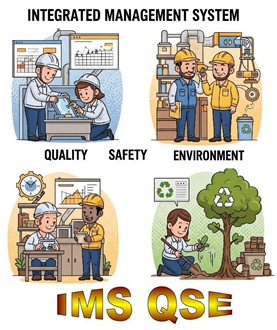
Description
Training program objectives
- become self-sufficient in implementing and managing your integrated management system
- accurately assess the effectiveness of your QSE (Quality, Safety and Environment) IMS through internal audits
- protect the physical and mental health of workers
- shift from a culture of remediation to a culture of prevention
- use regulatory monitoring tools
- prepare for ISO 9001, ISO 45001 and ISO 14001 certifications
- transform each process into an opportunity for improvement
- identify hazards and assess risks
- contribute to a safe and respectful work environment
- strengthen your environmental approach
- master risk management
Free quiz without registration on the requirements of the ISO 9001 standard that you can exercise by clicking on the "QUIZ" button:
Free quiz without registration on the requirements of the ISO 45001 standard that you can exercise by clicking on the "QUIZ" button:
F ree quiz without registration on the requirements of the ISO 14001 standard that you can exercise by clicking on the "QUIZ" button:
Readiness for implementation, certification, maintenance and improvement of your integrated quality, safety and environment management system in order to:
- increase the satisfaction of interested parties
- improve your overall performance
- seize opportunities for continual improvement
To conduct an audit according to ISO 19011 in order to:
- identify improvement opportunities
- increase the satisfaction of stakeholders
- evaluate the performance of the QSE integrated management system
See the set of documents Integrated QSE management system package readiness and internal audit version 2018 .png)
T 19v18 ONLINE COURSE FOR YOUR QSE (QUALITY, SAFETY, ENVIRONMENT) INTEGRATED MANAGEMENT SYSTEM VERSION 2018 .jpg)
This section of the online QSE training course introduces the principles, requirements, and challenges of an integrated quality, safety, and environmental management system. It provides the necessary foundation for structuring a coherent IMS and leading a continual improvement process within the company.
Discover the QSE standards and
- their contents
- their principles
- their requirements
- the stakes
Get used to
- process approach
- QSE terminology
- QSE manager function
- IMS QSE readiness documentation
- IMS QSE internal audit documentation
- risk approach
- continual improvement
- QSE tools
The important and fundamental elements of an integrated QSE management system
- quality approach (quality management principles, PDCA cycle)
- standards and specifications
- process approach (definitions, process types, mapping)
- IMS requirements (organization, scope, processes)
- leadership and commitment (management review)
- risks and opportunities
- resources, communication, documented information
- production and service provision
- performance evaluation
- continual improvement
This training allows for a better understanding of the organization of an integrated QSE management system and the development of a global vision of quality, safety and environmental requirements.
The menu of the course
- Presentation
- MCT (multiple-choice test) Beginning (10 questions)
- 1 Integrated system approach
- 1.1 Background
- 1.2 Common concepts
- 1.3 Principles, benefits, approach
- 2 Standards, definitions, books
- 2.1 Standards
- 2.2 Definitions
- 2.3 Books
- MCT Integrated management system approach (7 questions)
- 3 Process approach
- 3.1 Processes
- 3.1.1 Management process
- 3.1.2 Realization process
- 3.1.3 Support process
- 3.2 Process mapping
- 3.3 Process approach
- 3.1 Processes
- MCT Process approach (6 questions)
- 4 Context of the organization
- 4.1 The organization and its context
- 4.2 Needs and expectations of interested parties
- 4.3 Scope of the IMS
- 4.4 IMS and its processes
- Case Interested parties
- Case Customer & need
- Case Priority tasks
- MCT Context of the organization (8 questions)
- 5 Leadership
- 5.1 Leadership and commitment
- 5.2 Policy
- 5.3 Roles, responsibilities and authorities
- 5.4 Consultation and participation of workers
- Case New line
- MCT Leadership (7 questions)
- 6 Planning of the IMS
- 6.1 Actions to address risks and opportunities
- 6.2 QSE objectives
- 6.3 Planning of changes
- Case Environmental aspects
- Case Hazard identification
- MCT Planning of the IMS (10 questions)
- 7 Support
- 7.1 Resources
- 7.2 Competence
- 7.3 Awareness
- 7.4 Communication
- 7.5 Documented information
- Case Communication
- MCT Support (8 questions)
- 8 Operation
- 8.1 Operational planning and control
- 8.2 Requirements for products and services and emergency situations
- 8.3 Design and development
- 8.4 External providers
- 8.5 Production and service provision
- 8.6 Release of products and services
- 8.7 Control of outputs
- Case Design review
- Case Waste management
- Case Selecting suppliers
- Case Control means
- Case Process stability
- MCT Operation (9 questions)
- 9 Performance evaluation
- 9.1 Monitoring, measurement, analysis and evaluation
- 9.2 Internal audit
- 9.3 Management review
- Case Audit program
- Case Management review
- MCT Performance evaluation (9 questions)
- 10 Improvement
- 10.1 General
- 10.2 Nonconformity and corrective action
- 10.3 Continual improvement
- Case Kaizen & problem
- Case Nonconformities
- MCT Improvement (9 questions)
- MCT End (20 questions)
T 39v18 ONLINE COURSE INTERNAL AUDIT OF YOUR INTEGRATED QSE MANAGEMENT SYSTEM VERSION 2018
This second part is dedicated to the internal audit of the integrated QSE management system. It allows us to understand the role of the audit in the QSE approach, to identify the associated challenges and to master the tools useful for evaluating the performance of the system.
Discover the internal audit in a QSE certified company and
- locate the audit in the QSE approach
- identify the stakes
- understand the requirements
- control the tools
Get used to
- best practices
- good behavior
- the terminology
- the questionnaire
- the report
The important and fundamental elements of an internal audit
- scope
- normative references
- principles
- audit program (responsibilities, records)
- audit conducting (objectives, evidence, conclusions)
- auditor competence (knowledge, training)
The menu of the course
- Presentation
- MCT (multiple-choice test) Beginning (10 questions)
- 1 Scope
- 2 Normative references
- 3 Definitions
- 4 Principles
- 4.1 Management principles
- 4.2 Audit principles
- 4.3 IMS performance
- MCT Internal audit (6 questions)
- 5 Audit program
- 5.1 General
- 5.2 Objectives
- 5.3 Establishing
- 5.4 Implementing
- 5.5 Monitoring
- 5.6 Reviewing and improving
- Case Audit program
- MCT Audit program (11 questions)
- 6a Audit preparation
- 6.1 General
- 6.2 Initiating
- 6.2.1 First contact
- 6.2.2 Situations and feasibility
- 6.3 Preparing the audit
- 6.3.1 Document review
- 6.3.2 Audit plan
- Case Audit readiness
- MCT Audit preparation (8 questions)
- 6b Performing an audit
- 6.4 Audit activities
- 6.4.1 Opening meeting
- 6.4.2 Audit evidence
- 6.4.3 Audit conclusions
- 6.5 Audit report
- 6.6 Completing the audit
- 6.7 Audit follow-up
- 6.4 Audit activities
- Case Audit report
- Case Management review
- MCT Performing an audit (8 questions)
- 7 Competence and evaluation of auditors
- 7.1 General
- 7.2 Auditor competence
- 7.3 Evaluation criteria
- 7.4 Evaluation methods
- 7.5 Auditor evaluation
- 7.6 Improving competence
- Case Auditor question
- MCT Auditor competence (7 questions)
- MCT End (20 questions)

