


ISO 14001 requirements version 2026, environmental management systems
30/04/2026
Quiz requirements ISO 14001 version 2026 You want to familiarize yourself with the structure of the standard, identify and understand the requirements of ISO 14001 version 2026, then it's up to you to play!
The "ISO 14001 version 2026 Requirements" quiz will help you understand the main requirements of the standard.
The questions (requirements) included in this quiz are 45 of the 193 in the standard, but don't worry. These 45 requirements are among the most important. So do not hesitate to learn in a fun way!
Do not think you can finish this quiz in less than an hour, unless of course you are a little genius!
News on the ISO 14001 version 2026
Based on the ISO 14001: 2026 standard and some results of the public inquiry the 193 requirements (verb shall) in clauses 4 to 10 are as follows:
|
No
|
Clause
|
PDCA cycle
|
Requirement No
|
Quantity
|
|
4
|
Context of the organization | Plan | 1 ÷ 16 | 16 |
|
5
|
Leadership | Plan, Do, Check, Act |
17 ÷ 36
|
20
|
|
6
|
Planning | Plan |
37 ÷ 81
|
45
|
|
7
|
Support | Do |
82 ÷ 114
|
33
|
|
8
|
Operation | Do |
115 ÷ 133
|
19
|
|
9
|
Performance evaluation | Check |
134 ÷ 179
|
46
|
|
10
|
Improvement | Act |
180 ÷ 193
|
14
|
|
Total
|
193
|
|||

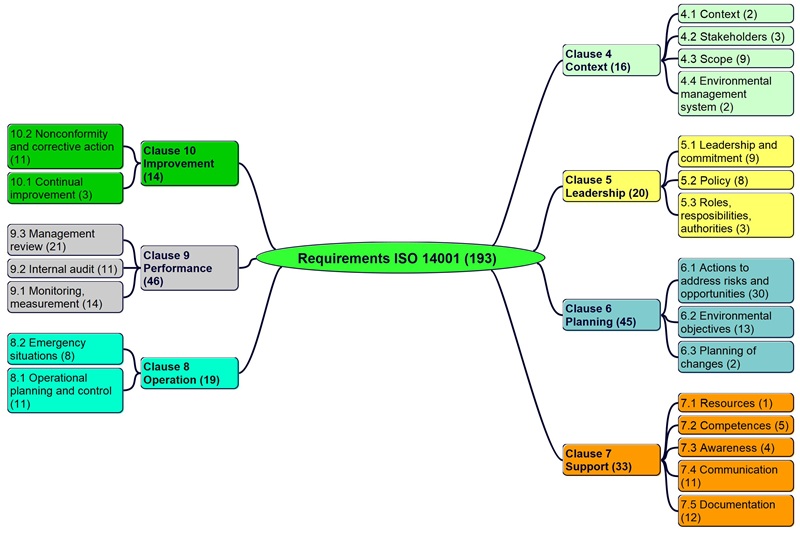
The requirements in clauses and sub-clauses of the ISO 14001: 2026 standard
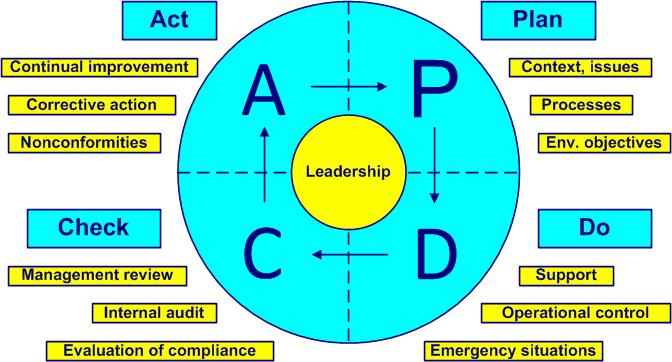
The PDCA cycle
Remark. Any requirement normally begins with "The organization shall...". For simplicity's sake we present the requirements directly, starting with the verb.
|
No
|
Clause, sub-clause
|
Requirement
|
Comment, link
|
|
| 4 |
Context of the organization
|
|||
| 4.1 |
The organization and its context
|
 |
||
|
4.1
|
Determine external and internal issues | Understanding everything that can influence its purpose, corporate culture, activities, strategic direction and the achievement of the intended outcomes of the environmental management system (EMS) and external circumstances (cultural, social, political, legal, financial, etc.) | ||
|
2
|
4.1
|
Include environmental conditions | All issues that can influence or be influenced by the company, such as pollution, air quality, natural resources, climate change, biodiversity, or ecosystem health. See ISO 14002, ISO 14055, ISO 14080, ISO 14090, and ISO 59014 standards | |
| 4.2 |
Needs and expectations of interested parties
|
|
||
|
3
|
4.2 a | Determine stakeholders | "There is only one valid definition of business purpose: to create a customer". Peter Drucker. Understand the environmental perspective of all stakeholders is a prerequisite | |
| 4 |
4.2 b
|
Determine the needs and expectations of stakeholders | These requirements may relate to pollution, natural resources, climate change, biodiversity, or the state of the ecosystem. | |
|
5
|
4.2 c
|
Determine its compliance obligations | When the company decides to comply with the legal requirements related to the EMS, these requirements become compliance obligations, see sub-clause 6.1.3 | |
| 4.3 |
Scope of the environmental management system
|
|
||
|
6
|
4.3
|
Determine the scope of the EMS | Geographic and organizational scope of the EMS | |
|
7
|
4.3 a
|
Take into account the external and internal issues | Cf. sub-clause 4.1 | |
|
8
|
4.3 b
|
Take into account the compliance obligations | Cf. sub-clause 4.2 | |
|
9
|
4.3 c
|
Take into account the units, functions and physical boundaries | Including subsidiaries when the organization decides to include them in the EMS | |
| 10 |
4.3 d
|
Take into account the activities, products and services | And the level of control and influence, including the life cycle. Above all, do not exclude activities, products, or services that may have significant environmental aspects. | |
| 11 | 4.3 e | Take into account the authority, control and influence of the organization | Over the life cycle of activities , products and services | |
|
4.3
|
Include in the EMS the scope, the activities, products and services | Cf. 6.1.2 | ||
| 13 | 4.3 | Keep the scope available in documented form | In documented form, cf. sub-clause 7.5 | |
| 14 | 4.3 | Keep the scope available | To stakeholders, cf. sub-clause 7.5 | |
| 4.4 |
Environmental management system
|
|
||
|
15
|
4.4
|
Establish, implement, maintain, update and improve the EMS | Incorporate the requirements of the EMS in business functions, processes and their interactions in order to achieve intended outcomes | |
| 16 | 4.4 | Take into account the context of the organization and stakeholders | When establishing and maintaining the EMS. Cf. sub-clauses 4.1 et 4.2 | |
| 5 |
Leadership
|
|||
| 5.1 |
Leadership and commitment
|
|
||
|
17
|
5.1 a
|
Demonstrate leadership (taking accountability for the effectiveness of the EMS) | "When you sweep the stairs, you start at the top". Romanian proverb. Top management assumes its responsibility and commitment | |
| 18 | 5.1 b | Establish an environmental policy and associated objectives | The policy and objectives are consistent with the strategic direction and business context | |
|
19
|
5.1 c
|
Integrate EMS requirements in the business processes | Cf. sub-clause 4.4 | |
|
20
|
5.1 d
|
Provide the necessary resources for the EMS | And ensure that these resources are really available. Cf. sub-clause 7.1 | |
|
21
|
5.1 e
|
Raise awareness on the importance of an effective and compliant EMS | Cf. sub-clause 7.3 | |
|
22
|
5.1 f
|
Ensure the achievement of intended outcomes of the EMS | Confirm in the management review (cf. sub-clause 9.3) | |
|
23
|
5.1 g
|
Support the staff contributing to the effectiveness of the EMS | Thanks to the acquired skills (cf. sub-clause 7.2) | |
|
24
|
5.1 h
|
Promote continual improvement | Essential commitment of top management (cf. sub-clause 10.3) | |
|
25
|
5.1 i
|
Support relevant roles | In order to demonstrate their leadership in their area, cf. sub-clause 5.3 | |
| 5.2 |
Environmental policy
|
|
||
|
26
|
5.2 a
|
Establish, implement and maintain an environmental policy | Appropriate for the corporate culture, including the nature, scale and environmental impacts | |
| 27 | 5.2 b | Establish, implement and maintain an environmental policy | Which provides a framework for establishing environmental objectives. Cf. sub-clause 6.2 | |
| 28 | 5.2 c | Establish, implement and maintain an environmental policy | Which includes environmental protection commitments (pollution prevention, water quality, air, biodiversity conservation). Be able to adapt to climate change | |
| 29 | 5.2 d | Establish, implement and maintain an environmental policy | Which includes meeting compliance obligations, cf. sub-clause 6.1.3 | |
| 30 | 5.2 e | Establish, implement and maintain an environmental policy | Which includes the commitment to continual improvement of the EMS. Be able to adapt to climate change, protecting biodiversity and ecosystems. Cf. sub-clause 10.1 | |
| 31 | 5.2 | Keep the environmental policy available | In documented form. Cf. sub-clause 7.5 | |
| 32 | 5.2 | Communicate the environmental policy | Internally. Cf. sub-clause 7.4 | |
| 33 | 5.2 | Keep the environmental policy available in documented form | To stakeholders | |
|
5.3
|
Roles, responsibilities and authorities
|
|
||
|
34
|
5.3
|
Assign responsibilities and authorities for relevant roles | Internally. Clarity of roles, responsibilities and authorities and intended outcomes | |
|
35
|
5.3 a
|
Assign responsibilities and authorities | In order to ensure that the EMS meets the requirements of the ISO 14001 standard | |
|
36
|
5.3 b
|
Assign responsibilities and authorities | In order to report on the performance of the EMS to top management, cf. sub-clause 9.3 | |
|
6
|
Planning
|
|||
| 6.1 |
Actions to address risks and opportunities
|
|
||
|
|
6.1.1 |
General
|
|
|
| 37 | 6.1.1 | Plan a specific process related to risks (threats and opportunities) | In order to determine risks and implement actions (cf. sub-clause 6.1.5) | |
|
38
|
6.1.1
|
Keep the process Manage risks | In documented form. Cf. sub-clauses 4.1, 4.2 and 4.3) | |
|
|
6.1.2 |
Environmental aspects
|
|
|
| 39 | 6.1.2 | Determine environmental aspects and their associated impacts | Determine which environmental aspects the company can influence, including from a life cycle perspective. This is a specific SME process. "Identifying aspects reduces impacts." An aspect is the cause, an impact is the effect. The life cycle primarily includes:
|
|
|
40
|
6.1.2
|
Determine potential emergency situations | Cf. sub-clauses 4.1, 4.2 and 4.3) | |
| 41 | 6.1.2 a | Take into account normal and abnormal conditions | Which are related to environmental aspects (cf. sub-clause 6.1.2), to compliance obligations (cf. sub-clause 6.1.3) and to issues (cf. sub-clauses 4.1, 4.2) | |
| 42 | 6.1.2 b | Take into account any change | To ensure that the EMS can achieve the objectives (cf. sub-clause 6.2), anticipate undesirable effects as external conditions in a continual improvement approach (cf. sub-clause 10.3) | |
| 43 | 6.1.2 c | Take into account potential emergency situations | Establish criteria to identify significant aspects. Aspects and activities that can have a significant impact on the environment (thus the risk that the organization may not achieve its environmental objectives) and on which the organization can influence as :
|
|
| 44 | 6.1.2 | Determine significant environmental aspects | Cf. sub-clause 7.5 | |
| 45 | 6.1.2 | Communicate its significant environmental aspects | In order to ensure that the results will be as planned | |
|
46
|
6.1.2
|
Keep environmental aspects and impacts | In documented form, cf. sub-clause 7.5 | |
|
47
|
6.1.2
|
Keep significant environmental aspects | In documented form, cf. sub-clause 7.5 | |
|
48
|
6.1.2
|
Keep Retain documented information on environmental aspects | In documented form, cf. sub-clause 7.5 | |
|
6.1.3
|
Compliance obligations
|
|
||
| 49 | 6.1.3 a | Identify compliance obligations of environmental aspects | "Nobody is supposed to ignore the law". Latin proverb. Cf. sub-clause 4.2. Compliance obligations can have a negative impact (risk) or a beneficial impact (opportunity) | |
|
50
|
6.1.3 b
|
Determine how these compliance obligations apply to the organization | Distinguish between mandatory legal requirements (laws, regulations, treaties, permits, licenses, agreements) and obligations to which the organization chooses to adhere (ISO 14001 certification, agreements with stakeholders, voluntary codes of conduct, voluntary labeling, sustainable development commitment) | |
|
51
|
6.1.3 c
|
Take into account compliance obligations regarding the EMS | During creation, implementation, maintenance and improvement of the EMS | |
|
52
|
6.1.3
|
Keep compliance obligations | In documented form, cf. sub-clause 7.5 | |
|
6.1.4
|
Risks and opportunity
|
|
||
|
53
|
6.1.4 a
|
Consider external and internal issues | In order to treat risks, significant environmental aspects and compliance obligations. Cf. sub-clauses 6.1.2 and 6.1.3 | |
|
54
|
6.1.4 b
|
Consider stakeholder needs and expectations | Integrate these actions in the internal ("business") processes. Establishing environmental objectives is one of those actions. Cf. sub-clause 6.2, clauses 7, 8 and sub-clause 9.1) | |
|
55
|
6.1.4 c
|
Consider the scope of the EMS | See section 4.3. Examples of threats (negative effects):
|
|
|
56
|
6.1.4
|
Determine the risks (threats and opportunities) | Related to environmental aspects (cf. sub-clause 6.1.2), compliance obligations (cf. sub-clause 6.1.3) and issues and requirements (cf. sub-clauses 4.1 and 4.2) | |
|
57
|
6.1.4
|
Give assurance that the EMS can achieve its intended outcomes | Cf. sub-clause 5.2. Examples of opportunities (beneficial effects):
|
|
|
58 |
6.1.4
|
Prevent or reduce undesired effects | Including when external environmental conditions affect the business | |
|
59
|
6.1.4
|
Achieve continual improvement | Cf. sub-clause 10.1 | |
|
60
|
6.1.4
|
Keep risks that need to be addressed | In documented form, cf. sub-clause 7.5 | |
|
Planning action
|
|
|||
|
61
|
6.1.5 a 1
|
Plan actions to address its significant environmental aspects | Cf. sub-clause 6.1.2. Include environmental requirements in design and develop processes | |
|
62
|
6.1.5 a 2
|
Plan actions to address its compliance obligations | Cf. sub-clause 6.1.3 | |
|
63
|
6.1.5 a 3
|
Plan actions to address risks (threats and opportunities) | Cf. sub-clause 6.1.4. Include environmental requirements for products and services provided by external suppliers | |
|
64
|
6.1.5 b 1
|
Plan how to implement actions into its EMS processes or integrate them into other business processes | Such as technological options, financial and operational conditions. Cf. sub-clauses 6.2, and 9.1 and clause 7 and 8) | |
|
65
|
6.1.5 b 2
|
Plan how to evaluate the effectiveness of these actions | Such as technological options, financial and operational conditions, cf. sub-clause 9.1 | |
|
66
|
6.1.5
|
Consider its technological options | As well as its financial, operational, and commercial requirements. Include end-of-life and disposal requirements in the marketing and sales processes | |
|
6.2
|
Environmental objectives and planning to achieve them
|
|
||
| 6.2.1 |
Environmental objectives
|
|
||
|
67
|
6.2.1 | Establish environmental objectives at relevant functions and levels | Consider the significant environmental aspects, compliance obligations and risks and opportunities. Find more information on the definition of environmental indicators in ISO 14031 | |
|
68
|
6.2.1 a | Establish environmental objectives | Consistent with the environmental policy | |
|
69
|
6.2.1 b | Establish environmental objectives | Measurable, if possible. When it is not realistic to measure an aspect we must be able to explain why | |
|
70
|
6.2.1 c | Establish environmental objectives | And monitor them | |
|
71
|
6.2.1 d | Establish environmental objectives | And communicate them | |
|
72
|
6.2.1 e | Establish environmental objectives | And update them | |
|
73
|
6.2.1 | Keep environmental objectives | In documented form, cf. sub-clause 7.5 | |
|
6.2.2
|
Planning actions to achieve environmental objectives
|
|
||
|
74
|
6.2.2 a | Determine actions to implement | When planning how to achieve its environmental objectives, in order to achieve them | |
|
75
|
6.2.2 b | Determine necessary resources | Cf. sub-clause 7.1 | |
|
76
|
6.2.2 c | Determine responsibilities | Cf. sub-clause 5.3 | |
|
77
|
6.2.2 d | Determine deadlines | "You can easily ignore instructions without deadline". Jean-François Zobrist | |
|
78
|
6.2.2 e | Determine how to evaluate results | Compare results and set objectives (cf. sub-clause 9.1.1). Monitor the progress of the environmental objectives indicators | |
|
79
|
6.2.2 | Consider how to integrate these actions into business processes | In order to achieve environmental objectives | |
|
6.3
|
Planning of changes
|
|
||
|
80
|
6.3 | Carry out changes in a planned manner | When changes impact the SME, such as new:
|
|
|
81
|
6.3 | Manage changes | To ensure that the intended outcomes of the EMS are achieved, such as:
|
|
| 7 |
Support
|
|||
| 7.1 |
Resources
|
|
||
|
82
|
7.1 | Determine and provide the resources needed | In order to establish, implement and improve the EMS (finances, people, infrastructure, know-how) | |
| 7.2 |
Competence
|
|||
| 83 | 7.2 a | Determine the necessary competence | Persons with environmental responsibilities (cf. sub-clause 5.3) and persons whose activities may cause a significant environmental impact (cf. sub-clause 6.1.2) | |
| 84 | 7.2 b | Ensure the competence | Which is based on training and appropriate experiences | |
| 85 | 7.2 c | Identify training needs | Training and support (external providers if necessary) on the environmental aspects and the EMS | |
| 86 | 7.2 d | Implement actions to acquire the necessary competence | Don't forget to evaluate the effectiveness of the actions | |
| 87 | 7.2 d | Keep evidence of competence | In documented form, cf. sub-clause 7.5 | |
| 7.3 | Awareness |
|
||
| 88 | 7.3 a | Ensure persons are aware of the environmental policy | Including external persons performing work under the organization's control. Cf. sub-clause 5.2 | |
| 89 | 7.3 b | Ensure persons are aware of the significant environmental aspects and impacts | And the impact on the workplace. Cf. sub-clause 6.1.2 | |
| 90 | 7.3 c | Ensure persons are aware of their contribution | In order to improve the performance of the EMS | |
| 91 | 7.3 d | Ensure persons are aware of the implications of not conforming | When the EMS requirements are not met including compliance obligations | |
| 7.4 |
Communication
|
|||
| 7.4.1 |
General
|
|
||
| 92 | 7.4.1 a | Plan and implement a communication process - on what | "Good news walks, bad news runs". Swedish proverb. Find more information on environmental communication in ISO 14063. Inform and receive information on:
|
|
| 93 | 7.4.1 b | Plan and implement a communication process - when | Quick response to complaints and claims but also to recommendations and proposals for improvement | |
| 94 | 7.4.1 c | Plan and implement a communication process - with whom | Internally and externally via those responsible for communication (cf. sub-clause 5.3) | |
| 95 | 7.4.1 d | Plan and implement a communication process - how | In writing, orally, Intranet, Internet, video, presentation, report | |
| 96 | 7.4.1 | Take into account its compliance obligations | Cf. sub-clause 6.1.3 | |
| 97 | 7.4.1 | Ensure that communication is adequate and reliable | Communication is clear, transparent, appropriate, factual, in good faith | |
| 98 | 7.4.1 | Respond to communications on its EMS | When appropriate. Attention because "Too much communication kills communication" | |
| 99 | 7.4.1 | Keep communication available | In documented form, cf. sub-clause 7.5 | |
| 7.4.2 |
Internal communication
|
|||
| 100 | 7.4.2 a | Communicate internally changes to the EMS | At all levels | |
| 101 | 7.4.2 b | Ensure that communication contributes to continual improvement | A person informed and aware is much more committed to improvement activities, cf. sub-clause 10.3 | |
| 7.4.3 |
External communication
|
|||
| 102 | 7.4.3 | Communicate externally relevant information on the EMS | As defined internally and according to the compliance obligations, cf. sub-clause 6.1.3 | |
| 7.5 |
Documented information
|
|||
| 7.5.1 |
General
|
|
||
| 103 | 7.5.1 a | Include in the EMS the documentation required by the ISO 14001 standard | Available documents:
|
|
| 104 | 7.5.1 b | Include the documentation determined as necessary for the effectiveness of the EMS | The aim is to ensure thanks to an appropriate documentation system an adequate and effective EMS. "Spoken words fly away, written ones stay". Latin proverb | |
| 7.5.2 |
Creating and updating
|
|||
| 105 | 7.5.2 a | Identify and describe the documents | Codification, title, author, subject, product | |
| 106 | 7.5.2 b | Choose format and media of the documents | Language, graphics, paper, electronic | |
| 107 | 7.5.2 c | Review and approve the adequacy of the documents | Who verifies, who approves | |
| 7.5.3 |
Control of documented information
|
|
||
| 108 | 7.5.3 a | Control the availability of the documents | Where and when required in a form that is suitable for use | |
| 109 | 7.5.3 b | Control the protection of the documents | Loss of confidentiality, loss of integrity, misuse | |
| 110 | 7.5.3 | Control the distribution, access and use of the documents | Who is responsible, method to use, rule to follow | |
| 111 | 7.5.3 | Control the storage of the documents | Including protection | |
| 112 | 7.5.3 | Control the changes of the documents | Use updated versions, limited access to outdated versions | |
| 113 | 7.5.3 | Control the retention and disposition of the documents | Retention period, disposal method | |
| 114 | 7.5.3 | Control the documents of external origin | Unique codification, access, protection, cf. sub-clause 7.5 | |
| 8 |
Operation
|
Do | ||
| 8.1 |
Operational planning and control
|
|||
| 115 | 8.1 | Plan and control the processes needed to meet the requirements of the EMS | Cf. sub-clauses 6.1 and 6.2. Including process criteria | |
| 116 | 8.1 | Implement actions to address risks by establishing operating criteria for the processes | In order to avoid gaps with the policy, objectives and compliance obligations | |
| 117 | 8.1 | Implement actions to address risks by implementing control of the processes | In accordance with the operating criteria | |
| 118 | 8.1 |
Control planned changes, review the consequences of unintended changes |
And to take action to mitigate any negative effects, cf. sub-clause 6.3 | |
| 119 | 8.1 | Ensure that externally provided processes, products or services are controlled or influenced | The level of environmental influence of outsourced processes is defined in the EMS. This level may be high but also low but the responsibility for meeting the requirements is owned by the organization | |
| 120 | 8.1 | Define the type and extent of control or influence of externally provided processes, products or services | For the EMS. Raise suppliers' awareness of environmental requirements. Conduct audits at the supplier's premises | |
| 121 | 8.1 a | Establish the necessary controls to ensure that environmental requirements are addressed in the design and development process | Considering each life cycle stage | |
| 122 | 8.1 b | Determine environmental requirements for the procurement of products and services | In order to take environmental requirements into account in all of the company's activities: | |
| 123 | 8.1 c | Communicate environmental requirements to external providers, including contractors | In relation to each life cycle stage. Cf. sub-clause 7.4. Include environmental requirements in purchase contracts
|
|
| 124 | 8.1 d | Provide information about potential significant environmental impacts | During delivery, use, end-of-life processing of the product and final disposal of products and services | |
| 125 | 8.1 | Keep operational processes available in documented form | To prove that the processes were carried out as planned. Cf. sub-clause 7.5 | |
| 8.2 |
Emergency preparedness and response
|
|
||
| 126 | 8.2 | Maintain the process to prevent emergency situations | In order to respond to emergencies take into account what is identified in sub-clause 6.1.2. Use the most appropriate methods | |
| 127 | 8.2 a | Plan your response to emergency situations | Be well prepared to reduce environmental impacts. Update evacuation routes. Maintain a list of people and relief agencies to contact with details (firefighters, clean-up service). Foresee mutual assistance with neighbor | |
| 128 | 8.2 b | Know how to respond to real emergencies | And communicate upstream internally and externally. Cf. sub-clause 7.4 | |
| 129 | 8.2 c | Undertake actions to reduce potential environmental consequences | The actions are proportional to the gravity of the emergencies and are specific to the situation | |
| 130 | 8.2 d | Periodically test how to respond to emergencies | Train staff to respond to emergencies and when possible simulate an emergency | |
| 131 | 8.2 e | Periodically review the "prevent emergency situations" process | And update as necessary especially after real emergencies | |
| 132 | 8.2 f | Communicate the "prevent emergency situations" process to stakeholders | Information and even relevant training courses, appropriately | |
| 133 | 8.2 | Keep available the "prevent emergency situations" process in documented form | In order to ensure that the process will be carried out as planned. Cf. sub-clause 7.5 | |
| 9 |
Performance evaluation
|
Check | ||
| 9.1 |
Monitoring, measurement, analysis and evaluation
|
|||
| 9.1.1 |
General
|
|||
| 134 | 9.1.1 | Evaluate the environmental performance of the organization | Monitor, measure, analyze and regularly evaluate the environmental performance to achieve environmental objectives. "If you can't measure it, you can't manage it". Peter Drucker | |
| 135 | 9.1.1 a | Determine what needs to be inspected (monitored and measured) and analyzed | Monitor and measure activities that can have a significant environmental impact | |
| 136 | 9.1.1 b | Determine the methods to be used | Choose the inspection method in order to obtain reliable, reproducible and traceable results | |
| 137 | 9.1.1 c | Determine the criteria and indicators | To evaluate the environmental performance use appropriate indicators arising from the environmental objectives (cf. sub-clause 6.2.1) | |
| 138 | 9.1.1 d | Determine when to inspect | Monitor and measure the essential steps that can have a significant environmental impact in relation to the analysis and evaluation | |
| 139 | 9.1.1 e | Determine when to analyze and evaluate | In order to ensure the validity of results (measurements are reliable and reproducible). The results are transmitted to those responsible to take action | |
| 140 | 9.1.1 | Ensure that the equipment is calibrated or verified | The use and maintenance of equipment is appropriate and consistent for reliable and reproducible results | |
| 141 | 9.1.1 | Communicate on environmental performance |
Internally and externally, and in accordance with compliance obligations. Cf. sub-clauses 7.4 and 6.1.3. Further details on environmental performance assessment can be found in ISO 14031. |
|
| 142 | 9.1.1 | Keep evidence of inspection, analysis and evaluation results | In documented form, cf. sub-clause 7.5 | |
| 9.1.2 |
Evaluation of compliance
|
|
||
| 143 | 9.1.2 | Establish, implement and maintain the process "evaluate the state of compliance obligations" | Periodically review all compliance obligations through :
|
|
| 144 | 9.1.2 a | Determine when to evaluate compliance | The evaluation frequency is appropriate | |
| 145 | 9.1.2 b | Evaluate compliance | And if necessary take action to restore compliance to the legal obligation | |
| 146 | 9.1.2 c | Maintain the state of compliance obligations | Maintain regulatory watch | |
| 147 | 9.1.2 | Keep available compliance evaluation results | In documented form, cf. sub-clause 7.5 | |
| 9.2 |
Internal audit
|
|||
| 9.2.1 |
General
|
|||
| 148 | 9.2.1 a 1 | Conduct planned regular internal audits | In order to determine whether the EMS conforms to internal requirements of the organization. Find more information about internal audit in ISO 19011. | |
| 149 | 9.2.1 a 2 | Conduct planned regular internal audits | In order to determine whether the EMS conforms to the requirements of the ISO 14001 standard | |
| 150 | 9.2.1 b | Conduct planned regular internal audits | In order to determine whether the EMS is efficient and updated | |
| 9.2.2 |
Internal audit program
|
|
||
| 151 | 9.2.2 | Plan, establish, implement and update an audit program | Include the frequency, methods, responsibilities and accountability of results. Take into account:
|
|
| 152 | 9.2.2 | Consider the environmental importance of processes | Do not forget:
|
|
| 153 | 9.2.2 a | Define the objectives, scope and audit criteria | Limit the area to be audited; use specific and known criteria by the auditee | |
| 154 | 9.2.2 b | Select auditors | Do not audit your department. "No one is judge in his own case". Latin proverb | |
| 155 | 9.2.2 c | Communicate audit results to top management and relevant persons | Consider any found nonconformity as an improvement opportunity Cf. sub-clause 7.4 | |
| 156 | 9.2.2 | Keep the audit program available | In documented form, cf. sub-clause 7.5 | |
| 157 | 9.2.2 | Keep evidence of the implementation of the audit program available | In documented form, cf. sub-clause 7.5 | |
| 158 | 9.2.2 | Keep evidence of the audit results available | Audit report, cf. sub-clause 7.5 | |
| 9.3 |
Management review
|
|
||
| 9.3.1 |
General
|
|||
| 159 | 9.3.1 | Perform the management review at least once a year | To confirm that the EMS is still relevant (EMS entered the corporate culture), adequate (meeting the requirements of ISO 14001) and effective (achieved the desired results). "No system is perfect" | |
| 9.3.2 |
Management review inputs
|
|||
| 160 | 9.3.2 a | Include in the management review inputs the status of actions from the previous management review | This allows us to verify the completion of all actions | |
| 161 | 9.3.2 b 1 | Include in the management review inputs changes in external and internal issues for the EMS | Relating to the EMS | |
| 162 | 9.3.2 b 2 | Include in the management review inputs changes in requirements of stakeholders | Including the status of compliance obligations and identified risks (cf. sub-clause 6.1.3) | |
| 163 | 9.3.2 b 3 | Include in the management review inputs changes in significant environmental aspects | Especially when new significant environmental aspects have been identified | |
| 164 | 9.3.2 b 4 | Include in the management review inputs changes in risks and opportunities | Cf. sub-clauses 6.1 and 6.3 | |
| 165 | 9.3.2 c | Include in the management review inputs the extent to which environmental objectives have been achieved | Cf. sub-clause 6.2 | |
| 166 | 9.3.2 d 1 | Include in the management review inputs information on environmental performance and trends in nonconformities and corrective actions | Cf. sub-clauses 9.1 and 10.2 | |
| 167 | 9.3.2 d 2 | Include in the management review inputs information on environmental performance and trends in inspection results | Cf. sub-clause 9.1 | |
| 168 | 9.3.2 d 3 | Include in the management review inputs information on environmental performance and trends in meeting compliance obligations | Cf. sub-clauses 9.1 and 6.1.3 | |
| 169 | 9.3.2 d 4 | Include in the management review inputs information on environmental performance and trends in audit results | Cf. sub-clause 9.2 | |
| 170 | 9.3.2 e | Include in the management review inputs adequacy of resources | Cf. sub-clause 7.1 | |
| 171 | 9.3.2 f | Include in the management review inputs feedback from stakeholders | Including complaints, cf. sub-clause 7.4 | |
| 172 | 9.3.2 g | Include in the management review inputs initiatives for continual improvement | Cf. sub-clause 10.1 | |
| 9.3.3 |
Management review results
|
|||
| 173 | 9.3.3 | Include in the results of the management review conclusions on the continuing suitability, adequacy and effectiveness | Of the EMS | |
| 174 | 9.3.3 | Include in the results of the management review decisions related to improvement opportunities | Of continual improvement, cf. sub-clause 10.1 | |
| 175 | 9.3.3 | Include in the results of the management review decisions related to any need for changes to the EMS | Including resources, cf. sub-clause 7.1 | |
| 176 | 9.3.3 | Include in the results of the management review actions | When environmental objectives have not been achieved | |
| 177 | 9.3.3 | Include in the results of the management review opportunities to improve integration of the EMS | With other business processes | |
| 178 | 9.3.3 | Include in the results of the management review any implications for the strategic direction of the organization | Cf. sub-clause 4.4 | |
| 179 | 9.3.3 | Keep available evidence of the results of the management review | In documented form, cf. sub-clause 7.5 | |
| 10 |
Improvement
|
Act | ||
| 10.1 |
Continual improvement
|
|||
| 180 | 10.1 | Improve continually the suitability, adequacy and effectiveness of the EMS | In order to enhance environmental performance | |
| 181 | 10.1 | Improve continually the suitability, adequacy and effectiveness of the EMS by determining opportunities for improvement | Including every innovation. Cf. clause 9 | |
| 182 | 10.1 | Improve continually the suitability, adequacy and effectiveness of the EMS by implementing actions | In order to achieve the intended outcomes | |
| 10.2 |
Nonconformity and corrective action
|
|
||
| 183 | 10.2 a 1 | React to the nonconformity and correct it | Carry out a corrective action | |
| 184 | 10.2 a 2 | Reduce negative environmental impacts | Take into account the context of the organization (cf. sub-clause 4.1) and perform actions to address the risks (cf. sub-clause 6.1) | |
| 185 | 10.2 b 1 | Evaluate whether action is needed by performing a nonconformity review | The goal is to find and eliminate the root causes and prevent a recurrence of the nonconformity | |
| 186 | 10.2 b 2 | Investigate the root causes | Realize an analysis of the root causes | |
| 187 | 10.2 b 3 | Find if similar nonconformities have been listed | If so draw conclusions with appropriate actions | |
| 188 | 10.2 c | Implement the necessary actions | To prevent a recurrence of the nonconformity | |
| 189 | 10.2 d | Review the effectiveness of the corrective action | In order to check if the action is finalized | |
| 190 | 10.2 e | Make changes to the EMS | If needed | |
| 191 | 10.2 | Choose corrective actions proportionate to the importance of the nonconformities | Including environmental impacts | |
| 192 | 10.2 | Keep the nature of nonconformities and actions carried out available | In documented form, cf. sub-clause 7.5 | |
| 193 | 10.2 | Keep the results of the corrective action available | In documented form, cf. sub-clause 7.5 | |
|
|
|
|||

