


News on the ISO 14001 standard version 2026 - Environmental management systems - requirements with guidance for use
April 30, 2026
The ISO 14001:2026 standard was published on April 15, 2026.
The 2026 version reinforces certain principles and adds new requirements.
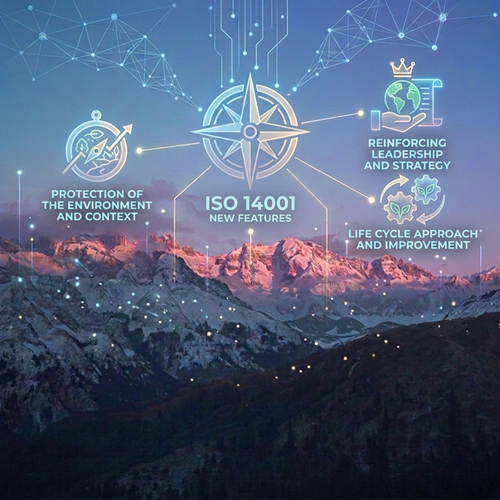
The changes concern:
- increased focus on climate change, analysis of the organizational context, pollution levels, biodiversity, and the availability of natural resources
- environmental risk analysis (threats and opportunities) is more closely linked to climate change
- top management is more actively involved in environmental objectives and performance improvement
- change management and planning are strengthened (new paragraph)
- lifecycle impacts throughout the supply chain are considered to build resilience and adaptability
- digitalization of processes and data in environmental management systems is enhanced
- internal and external communication is more transparent and accessible
- operational controls and scope are extended to outsourced processes and externally provided products and services
- emergency preparedness is improved by strengthening awareness, response, and resilience
- the input elements for management review are now listed
- Annex A (informative) has been expanded and improved to facilitating the interpretation of the various requirements
Details of the new features:
- Clause 4
- The 2024 amendment on climate change is now integrated into the text of the standard itself
- Environmental conditions such as climate change, biodiversity, natural resources, pollution, and the availability of natural resources must be taken into account in their contextual analysis and in the determination of internal and external issues during the context analysis
- Better integration of environmental factors into the overall business context
- Emphasis on stakeholder requirements (sustainability requirements, evolution of expectations)
- Review and update stakeholder list and their needs
- The scope must take into account the organization's authority and capacity to exercise control and influence over the life cycle of its activities, products, and services
- Clause 5
- Priority is given to ethical leadership, full accountability, and the promotion of an environmental and sustainable development culture
- Active and measurable commitment
- The new note now proposes additional specific management commitments: sustainable use of resources, climate change mitigation, and protection of biodiversity and ecosystems
- Clause 6
- Significant environmental aspects cover the entire life cycle perspective (from design to disposal)
- Aspects to be considered now include potential emergency situations, which are no longer considered reasonably foreseeable
- New sub-clause 6.1.4 Risks and Opportunities
- Sub-clause 6.3 introduces change planning to anticipate environmental impacts during organizational or technical modifications; examples are in Annex A.6.3
- Clause 8
- Integration of indirect environmental impacts related to suppliers, carriers (carbon footprint of logistics), and customers (use and end-of-life of products)
- Clause 9
- Relevant environmental performance indicators are measured and communicated to stakeholders
- Each internal audit must define one or more objectives
- Introduction of three sub-clauses; the input elements are explicitly listed
- Article 10
- Sub-clauses 10.2 and 10.3 are integrated into sub-clause 10.2
- Traceability of supplier-related non-conformities
Terminology:
- Term "outcome" refers to strategic intent and direction, whereas "result" refers to achievements already attained
- Documentation (documented information) is now available and not maintained or retained as evidence of
- "Meet compliance obligations" replaces "fulfil compliance obligations"
- The term "outsourcing" is deleted
- The phrase "outsourced processes" is replaced by "processes, products, or services provided by external providers or suppliers"
Preparing for the 2026 transition:
- Involve top management without delay
- Review the context of your environmental management system (EMS) to include climate and supply chain considerations
- Review your environmental policy (with an emphasis on sustainability)
- Update stakeholder and risk registers
- Improve your lifecycle practices
- Change your internal audit and management review processes
The T 17v26 ISO 14001:2026 Readiness training course and its free demo (no registration required)
The T 37v26 ISO 14001:2026 Internal Audit training course and its free demo without registration
Documentation
The mandatory documents are now available:
- Scope of the EMS (sub-clause 4.3)
- Environmental policy (sub-clause 5.2)
- Risk management (sub-clause 6.1.1)
- Environmental aspects (sub-clause 6.1.2)
- Compliance obligations (sub-clause 6.1.3)
- Risks (sub-clause 6.1.4)
- Environmental objectives (sub-clause 6.2.1)
- Staff competence (sub-clause 7.2)
- Communication (sub-clause 7.4.1)
- Documents of external origin (sub-clause 7.5.3)
- Operational processes (sub-clause 8.1)
- Emergency situations (sub-clause 8.2)
- Inspection results (sub-clause 9.1.1)
- Compliance evaluation (sub-clause 9.1.2)
- Audit program and audit results (sub-clause 9.2.2)
- Results of management review (sub-clause 9.3.3)
- Nature of nonconformities, corrective actions, and results (sub-clause 10.2)
ISO 14001:2026 requirements
In clauses 4 to 10, the verb "shall" is used 193 times
Details of Clauses and Sub-clauses
Foreword
Introduction
0.1 Background
0.2 Aim of an Environmental Management System
0.3 Success Factors
0.4 Plan-Do-Check-Act model
0.5 Contents of this document
1 Scope
2 Normative References
3 Terms and Definitions
3.1 Terms related to organization and leadership
3.2 Terms related to planning
3.3 Terms related to support and operation
3.4 Terms related to performance evaluation and improvement
4 Context of the Organization
4.1 Understanding the organization and its context
4.2 Understanding the needs and expectations of interested parties
4.3 Determining the scope of the environmental management system
4.4 Environmental management system
5 Leadership
5.1 Leadership and commitment
5.2 Environmental policy
5.3 Roles, responsibilities, and authorities
6 Planning
6.1 Actions to address risks and opportunities
6.1.1 General
6.1.2 Environmental aspects
6.1.3 Compliance obligations
6.1.4 Risks and opportunities
6.1.5 Planning action
6.2 Environmental objectives and planning to achieve them
6.2.1 Environmental objectives
6.2.2 Planning actions to achieve environmental objectives
6.3 Change Planning
7 Support
7.1 Resources
7.2 Competence
7.3 Awareness
7.4 Communication
7.4.1 General
7.4.2 Internal communication
7.4.3 External communication
7.5 Documented Information
7.5.1 General
7.5.2 Creating and updating documented information
7.5.3 Control of documented information
8 Operation
8.1 Operational planning and control
8.2 Emergency preparedness and response
9 Performance Evaluation
9.1 Monitoring, measuring, analyzing, and evaluating
9.1.1 General
9.1.2 Evaluation of compliance
9.2 Internal audit
9.2.1 General
9.2.2 Internal audit program
9.3 Management Review
9.3.1 General
9.3.2 Management review inputs
9.3.3 Management review results
10 Improvement
10.1 Continual improvement
10.2 Nonconformity and corrective action
Annex A (Informative) Guidelines on the use of this document
Bibliography
Index
Some Comments
- Still no requirement for process mapping
- Staff motivation and engagement are not addressed (but at least staff awareness is included)

