


ISO 9001 version 2026 requirements, quality management systems
1/10/2026
Quiz requirements ISO 9001 version 2026 You want to familiarize yourself with the structure of the standard, identify and understand the requirements of ISO 9001 version 2026, then it's up to you to play!
The "ISO 9001 version 2026 Requirements" quiz will help you understand the main requirements of the standard.
The questions (requirements) included in this quiz are 60 of the 332 in the standard, but don't worry. These 60 requirements are among the most important. So do not hesitate to learn in a fun way!
Do not think you can finish this quiz in less than an hour, unless of course you are a little genius!
News about the ISO 9001 version 2026
The online training (course) T 15v26 ISO 9001 version 2026 readiness and its demo
The course T 35v26 ISO 9001 version 2026 internal audit and its demo
The package of courses T 75v26 training package ISO 9001 version 2026 readiness and internal audit
Based on the ISO 9001: 2015 the 310 requirements (verb shall) of clauses 4 to 10 are as follows:
|
No
|
Clause
|
PDCA cycle
|
Requirement No
|
Quantity
|
|
4
|
Context | Plan | 1 to 27 | 27 |
|
5
|
Leadership | Plan, Do, Check, Act |
28 to 59
|
32
|
|
6
|
Planning | Plan |
60 to 95
|
36
|
|
7
|
Support | Do |
96 to 139
|
44
|
|
8
|
Operation | Do |
140 to 268
|
129
|
|
9
|
Performance | Check |
269 to 314
|
46
|
|
10
|
Improvement | Act |
315 to 332
|
18
|
|
Total
|
332
|
|||

.jpg)
ISO 9001 version 2026 requirements
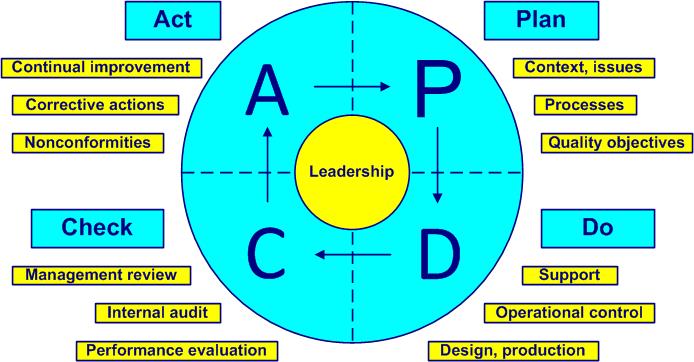
The Deming PDCA cycle
Remark. Any requirement normally begins with "The organization shall...". For simplicity's sake we present the requirements directly, starting with the verb.
|
No
|
Clause, sub-clause
|
Requirement
|
Comment, link
|
|
| 4 |
Context of the organization
|
|||
| 4.1 |
The organization and its context
|
 |
||
|
4.1
|
Determine external and internal issues | Understand everything that can influence the purpose and strategic direction of the company (corporate culture, innovation, strategic direction, competition, market, compliance obligation). Cf. sub-clause 6.1 | ||
| 2 | 4.1 |
Determine whether climate change is a relevant issue |
Amendment 1 of ISO 9001 (february 2024) : changes concerning actions related to climate. It is a requirement! | |
| 3 | 4.1 | Monitor and review information about issues |
Issue: what one can gain or lose during an activity (factors, conditions). Some issues can change rapidly, so remain vigilant. Cf. sub-clause 9.3 |
|
| 4.2 |
Needs and expectations of stakeholders
|
|
||
| 4.2 a | Identify stakeholders | "There is only one valid definition of a business purpose: to create a customer". Peter Drucker. List of relevant stakeholders, sub-clause. § 7.5 | ||
| 5 |
4.2 b
|
Clarify the requirements of the stakeholders | Each need and expectation is unique. Aim for a partnership in the long term | |
|
6
|
4.2 c
|
Determine which of these requirements will be addressed | Through the quality management system | |
|
7
|
4.2
|
Monitor and review information about stakeholders and their requirements | Before accepting an order | |
| 4.3 |
Scope of the quality management system
|
|
||
|
8
|
4.3
|
Define the scope of the QMS | Geographic and organizational scope available to stakeholders | |
|
9
|
4.3 a
|
Take into consideration the external and internal issues | Cf. sub-clause 4.1 | |
|
10
|
4.3 b
|
Take into consideration the requirements of the stakeholders | Cf. sub-clause 4.2 | |
|
11
|
4.3 c
|
Take into consideration the products and services | All products and services proposed by the company without exception | |
| 12 |
4.3
|
Apply any requirement of the ISO 9001 standard applicable within the scope of the QMS | The requirements of the standard become internal requirements | |
| 13 | 4.3 | Keep the scope of the QMS available as documented information | Cf. sub-clause 7.5 | |
|
4.3
|
Include in the scope of the QMS justification for any requirements which cannot be met | Any requirement of the ISO 9001 standard that cannot be applied within the organization must be justified, as "requirements determined to be non-applicable do not affect the organization’s ability or responsibility to ensure the conformity of its products and services and the enhancement of customer satisfaction." | ||
|
4.3
|
Keep the scope available | As documented information, cf. sub-clause 7.5 | ||
| 4.4 |
Quality management system and its processes
|
|
||
|
16
|
4.4.1
|
Establish, implement, maintain and improve a process-based QMS including process interactions | The company is free to decide how to apply the QMS without forgetting the issues (see sub-clause 4.1) and requirements (see sub-clause 4.2). Process map | |
| 17 | 4.4.1 a | Determine the needed processes | And their application | |
|
18
|
4.4.1 b
|
Determine process inputs and outputs | Process sheet, process owner job description, cf. sub-clause 5.3 | |
| 19 | 4.4.1 c | Determine the sequence and interaction of processes | Flowchart | |
| 20 | 4.4.1 d | Determine the criteria and methods to control processes | Tools of the quality manager, cf. sub-clause 9.1.1 | |
| 21 | 4.4.1 e | Determine and ensure the resources | Needed to support processes. Cf. sub-clause 7.1. And ensure their availability | |
| 22 | 4.4.1 f | Assign process responsibilities and authorities | Job description of process owners, cf. sub-clause 5.3 | |
| 23 | 4.4.1 g | Address the risks and opportunities for each process | In accordance with the requirements in sub-clause 6.1 | |
| 24 | 4.4.1 h | Evaluate processes and if necessary implement any changes needed | In order to ensure that these processes achieve their intended results | |
| 25 | 4.4.1 i | Determine the improvement opportunities of processes and the QMS | Cf. sub-clause 10.1 | |
|
26
|
4.4.2 a
|
Keep documented information available to the extent necessary (procedures) | In order to support the operation of the organization's processes. Cf. sub-clause 7.5 | |
|
27
|
4.4.2 b
|
Keep documented information available to the extent necessary (records) | As evidence that the processes are being carried out as planned. Cf. sub-clause 7.5 | |
| 5 |
Leadership
|
|||
| 5.1 |
Leadership and commitment
|
|||
|
|
5.1.1 |
General
|
|
|
|
28
|
5.1.1 a
|
Establish a quality policy and quality objectives, and demonstrate commitment to the QMS | The policy and objectives are consistent with the company’s strategic direction and context. "When you sweep the stairs, you start at the top". Romanian proverb. Focus on quality and customers | |
| 29 | 5.1.1 b | Integrate QMS requirements in the internal process requirements | Cf. sub-clause 4.4 and sub-clause 7.1.4 | |
|
30
|
5.1.1 c
|
Provide the necessary resources for the QMS | And ensure their availability, cf. sub-clause 7.1 | |
|
31
|
5.1.1 d
|
Raise awareness on the importance of an effective and conforming QMS | Essential management commitment to a customer focus, cf. sub-clause 5.1.2 | |
|
32
|
5.1.1 e
|
Ensure the achievement of intended results of the QMS | Third quality management principle (engagement of people) | |
|
33
|
5.1.1 f
|
Support the staff contribution to the effectiveness of the QMS | "Employees first, customers second". Vineet Nayar | |
|
34
|
5.1.1 g
|
Promote continual improvement | Cf. sub-clause 10.1 | |
|
35
|
5.1.1 h
|
Support the leadership of managers | Responsibility and authority of managers are backed at all times by top management | |
|
36
|
5.1.1 i
|
Promote quality culture | And ethical behavior (shared values, attitudes and practices), cf. ISO 10010 | |
|
37
|
5.1.1 j
|
Promote the process approach | Cf. sub-clause 0.3 of the Introduction | |
|
38
|
5.1.1 k
|
Promote the risk approach | Cf. sub-clause 6.1 | |
|
39
|
5.1.1 l
|
Take accountability for the effectiveness of the QMS | Top management demonstrates leadership (assumes its responsibility and commitment) | |
|
|
5.1.2
|
Customer focus
|
|
|
|
40
|
5.1.2 a
|
Determine and meet customer, statutory and regulatory requirements | Top management demonstrates leadership (assumes its responsibility and commitment) permanently, cf. sub-clause 8.2 | |
|
41
|
5.1.2 b
|
Determine and address the potential risks and opportunities | Any risk and opportunity that may influence the conformity of products and services and customer satisfaction. Preserving the goal to always provide compliant products and services | |
|
42
|
5.1.2 c
|
Maintain the objective of better satisfying the customer | First quality management principle (customer focus), cf. sub-clause 9.1.2 | |
| 5.2 |
Policy
|
|
||
|
43
|
5.2.1
|
Establish a quality policy | Taking into account the company’s purpose (its *raison d’être*, strategic direction, culture, and business context) | |
| 44 | 5.2.1 a | Ensure that the quality policy is appropriate | To the purpose of the organization | |
| 45 | 5.2.1 b | Provide a framework to define and review the quality objectives | Cf. sub-clause 6.2 | |
| 46 | 5.2.1 c | Include meeting the applicable requirements | Cf. sub-clause 9.1.3 | |
| 47 | 5.2.1 d | Include a commitment to continually improve the QMS | Cf. sub-clause 10.1 | |
| 48 | 5.2.1 e | Take into account the context of the organization | And support its strategic direction | |
| 49 | 5.2.2 a | Keep the quality policy available as documented information | And make it available inside the company. Cf. sub-clause 7.5 | |
| 50 | 5.2.2 b | Communicate the quality policy | So it is understand and applied, cf. sub-clause 7.4 | |
| 51 | 5.2.2 c | Keep the quality policy available | The quality policy cannot be a confidential document, it is available to relevant stakeholders | |
| 52 | 5.2.2 d | Implement and make the quality policy understood | And applied within the organization | |
|
5.3
|
Roles, responsibilities, authorities
|
|
||
|
53
|
5.3
|
Assign and communicate the responsibilities and authorities | Top management ensures that all relevant roles in the QMS are assigned | |
|
54
|
5.3 a
|
Assign and communicate the responsibilities and authorities | In order to ensure that the QMS conforms to the requirements of the ISO 9001 standard | |
|
55
|
5.3 b
|
Assign and communicate the responsibilities and authorities | In order to report on the performance of the QMS to top management | |
|
56
|
5.3 c
|
Assign and communicate the responsibilities and authorities | In order to ensure that the processes are delivering their intended results, cf. sub-clause 8.5.1 | |
|
57
|
5.3 d
|
Assign and communicate the responsibilities and authorities | In order to ensure that customer focus is ensured (first quality management principle), cf. sub-clauses 5.1 and 7.3 | |
|
58
|
5.3 e
|
Assign and communicate the responsibilities and authorities | In order to report on opportunities for improvement to top management, sub-clause 10.1 | |
|
59
|
5.3 f
|
Assign and communicate the responsibilities and authorities | In order to ensure that the integrity of the QMS is maintained, including when changes are planned and implemented | |
|
6
|
Planning
|
|||
| 6.1 |
Actions to address risks and opportunities
|
|
||
| 6.1.1 |
Determining risks and opportunities
|
|
||
| 60 |
6.1.1 a
|
Consider the external and internal issues and determine the risks and opportunities | In order to ensure that the QMS can achieve its expected results, cf. sub-clauses 4.1 (context) and 4.2 (stakeholders). "Any decision involves a risk". Peter Barge | |
| 61 | 6.1.1 b | Consider the external and internal issues and determine the risks and opportunities | In order to prevent, or reduce, undesired effects | |
|
62
|
6.1.1 c
|
Consider the external and internal issues and determine the risks and opportunities | In order to achieve continual improvement, cf. sub-clause 10.1 | |
| 63 | 6.1.1 d | Consider the external and internal issues and determine the risks and opportunities | In order to enhance desired effects | |
| 6.1.2 |
Actions to address risks
|
|
||
| 64 | 6.1.2 | Determine, analyze and evaluate risks | That can have an undesired effect on products and services and customer satisfaction. Possible actions: avoid the risk, take a risk in order to seize an opportunity, eliminate the source of the risk, share the risk | |
| 65 | 6.1.2 a | Plan actions | In order to address these risks | |
| 66 | 6.1.2 b 1 | Plan how to integrate | And implement the actions into its QMS processes | |
| 67 | 6.1.2 b 2 | Plan how to evaluate | The effectiveness of these actions | |
| 68 | 6.1.2 | Adapt actions to risks | Compared to the potential impact of the risks on the intended results of the QMS | |
|
6.1.3
|
Actions to address opportunities
|
|
||
|
69
|
6.1.3
|
Determine, analyze and evaluate opportunities |
Capable of having a desired impact on products, services, and customer satisfaction. Possible actions include new practices, new products, new partnerships, new technologies, and initiatives designed to address the evolving needs and expectations of customers |
|
| 70 | 6.1.3 a | Plan the actions | In order to address these opportunities | |
|
71
|
6.1.3 b
|
Plan how to integrate | And implement the actions into its QMS processes | |
|
72
|
6.1.3 c
|
Plan how to evaluate | The effectiveness of these actions | |
| 73 | 6.1.3 | Adapt actions to opportunities | Compared to the organization's context and support the achievement of desired results | |
|
6.2
|
Quality objectives
|
|
||
|
74
|
6.2.1
|
Establish quality objectives for processes | "He who has no goals will not achieve them". Sun Tzu" | |
| 75 | 6.2.1 a | Choose quality objectives | Clarify criteria for setting objectives that are consistent with the quality policy | |
|
76
|
6.2.1 b
|
Use measurable objectives | And realistic | |
|
77
|
6.2.1 c
|
Consider applicable requirements | Cf. sub-clause 4.2 | |
| 78 | 6.2.1 d | Monitor objectives |
Frequently |
|
| 79 | 6.2.1 e | Communicate on objectives | At all levels | |
|
80
|
6.2.1 f
|
Update objectives | During management review, cf. sub-clause 9.3 | |
| 81 | 6.2.1 g | Keep available as documented information the quality objectives | Cf. sub-clause 7.5 | |
| 82 |
6.2.1 h
|
Keep the quality objectives relevant | To the conformity of products and services and the ability to enhance customer satisfaction | |
| 83 |
6.2.2 a
|
Determine how to do | In order to achieve its quality objectives | |
| 84 |
6.2.2 b
|
Determine what resources will be required | In order to achieve its quality objectives | |
| 85 |
6.2.2 c
|
Determine who will be responsible | In order to achieve its quality objectives | |
| 86 |
6.2.2 d
|
Determine deadlines | In order to achieve its quality objectives | |
| 87 |
6.2.2 e
|
Determine how the results will be evaluated | In order to achieve its quality objectives | |
| 6.3 |
Planning of changes
|
|
||
|
88
|
6.3 | Plan the need for changes to the QMS in a planned manner | "The only person who likes change is a wet baby". Cf. sub-clause 4.4 | |
|
89
|
6.3 a | Plan the changes | Taking into account the purpose of the change and the possible consequences | |
|
90
|
6.3 b | Plan the changes | Taking into account the maintenance of the integrity of the QMS | |
|
91
|
6.3 c | Plan the changes | Taking into account the available resources and information | |
|
92
|
6.3 d | Plan the changes | Taking into account the allocation and reallocation of responsibilities and authorities | |
|
93
|
6.3 e | Plan the changes | Taking into account the communication of the changes | |
|
94
|
6.3 f | Plan the changes | Taking into account how the effectiveness of the changes will be monitored and evaluated | |
|
95
|
6.3 g | Plan the changes | Taking into account how the results of the changes will be reviewed | |
| 7 |
Support
|
|||
| 7.1 |
Resources
|
|
||
|
|
7.1.1
|
General
|
|
|
|
96
|
7.1.1 | Provide the necessary resources | In order to support the QMS, cf. sub-clause 9.3 | |
|
97
|
7.1.1 a | Take into account existing resources | And their capabilities and constrains, cf. sub-clause 7.1.2 | |
|
98
|
7.1.1 b | Take into account the need for the use of external providers | In order to provide necessary services not available inside the company | |
|
|
7.1.2 |
People
|
|
|
|
99
|
7.1.2 |
Provide suitable people for the effective operation of the QMS and its processes |
"But in the long run - and I emphasize this - no matter how good or successful you are or how clever or crafty, your business and its future are in the hands of the people you hire". Akio Morita." Cf. ISO 30201 |
|
|
7.1.3
|
Infrastructure | |||
|
100
|
7.1.3 | Provide and maintain the infrastructure necessary to the functioning of processes | In order to achieve conformity of products and services. Examples: buildings, equipment, transportation, hardware, software, cf. ISO 30201 | |
|
7.1.4
|
Process environment | |||
|
101
|
7.1.4 | Provide and maintain the suitable environment necessary to the functioning of processes | In order to achieve conformity of products and services. Examples: corporate culture, work atmosphere, temperature, ergonomics | |
| 7.1.5 |
Monitoring and measuring resources
|
|
||
| 7.1.5.1 |
General
|
|
||
|
102
|
7.1.5.1 | Provide suitable monitoring and measuring resources | In order to obtain expected inspection results, cf. ISO 10012 and ISO 10009 | |
|
103
|
7.1.5.1 a
|
Provide adequate resources to the specific inspections | To inspect is to monitor and measure. Cf. sub-clause 7.2 | |
| 104 | 7.1.5.1 b | Maintain resources | In order to ensure fitness for their purpose | |
| 105 | 7.1.5.1 | Keep documented information available as evidence on the adequacy of inspection resources | Cf. sub-clause 7.5 | |
| 7.1.5.2 |
Measurement traceability
|
|
||
| 106 | 7.1.5.2 a | Verify or calibrate regularly the measuring equipment | In order to have confidence in the measurement results. When no such standards exist keep documented information available as evidence on the reference used, cf. sub-clause 7.5 | |
| 107 | 7.1.5.2 b | Identify the measuring equipment | In order to monitor the validity of their calibration (or verification) | |
| 108 | 7.1.5.2 c | Protect the measuring equipment | Against activities that may invalidate the results of the measurement (settings or deterioration) | |
| 109 | 7.1.5.2 | Conduct corrective action on previous measurement results | When the verification or calibration of a measuring instrument is not in conformity | |
|
|
7.1.6
|
Organizational knowledge | ||
| 110 | 7.1.6 | Determine the necessary knowledge | In order to control the processes and the conformity of products and services, cf. ISO 30401 | |
| 111 | 7.1.6 | Acquire, maintain and make organizational knowledge available to the extent necessary | In order to maintain the performance of the QMS, cf. sub-clause 7.2 | |
| 112 | 7.1.6 | Take into account the need for additional knowledge | When needs and trends have changed | |
| 7.2 |
Competence
|
|||
| 113 | 7.2 a | Determine the necessary competence | Clarify quality competence requirements. Identify people who have an influence on the quality performance, cf. ISO 10015 | |
| 114 | 7.2 b | Ensure that these persons are competent | Which are based on appropriate education, training or experience | |
| 115 | 7.2 c | Undertake actions to acquire the necessary competence and evaluate the effectiveness of these actions | Training, coaching, external providers | |
| 116 | 7.2 | Keep appropriate documented information available on staff competence | Cf. sub-clause 7.5 | |
| 7.3 | Awareness |
|
||
| 117 | 7.3 a | Ensure the staff is aware of the quality policy | Including people who carry out work under the company's control. Cf. sub-clause 5.2 and ISO 10018 | |
| 118 | 7.3 b | Ensure the staff is aware of their contribution to the effectiveness of the QMS | Including the benefits of improved performance | |
| 119 | 7.3 c | Ensure the staff is aware of the implications | Of not conforming to the QMS requirements, cf. sub-clause 8.7 | |
| 120 | 7.3 d | Ensure the staff is aware of relevant quality objectives | If QMS requirements are not met. Cf. sub-clause 6.2 | |
| 121 | 7.3 d | Ensure the staff is aware of the organizational quality culture | And ethical behavior | |
| 7.4 |
Communication
|
|||
| 122 | 7.4 a | Define the subjects on which to communicate | Internally and externally. "Good news walks, bad news runs". Swedish proverb | |
| 123 | 7.4 b | Define when to communicate | Respond quickly to claims | |
| 124 | 7.4 c | Define with whom to communicate | Communication goes both ways | |
|
125
|
7.4 d
|
Define how to communicate | Orally, in writing; Internet, video | |
|
126
|
7.4 e
|
Assign who will communicate | The one who is closest to the subject | |
| 7.5 |
Documentation
|
|||
| 7.5.1 |
General
|
|
||
| 127 | 7.5.1 a | Include the documentation required by the ISO 9001 standard | Documented procedures (documented information to keep available):
|
|
| 128 | 7.5.1 b | Select the documentation deemed necessary to the effectiveness of the QMS | "Spoken words fly away, written one stay". Latin proverb | |
| 7.5.2 |
Creating and updating
|
|
||
| 129 | 7.5.2 a | Create, identify and describe the documentation | Codification, title, author, subject, product, cf. ISO 10013 | |
| 130 | 7.5.2 b | Choose the format and the media of the documentation | Language, graphics; paper, electronic | |
| 131 | 7.5.2 c | Review and approve the adequacy of the documentation | Who writes, codifies, who approves | |
| 7.5.3 |
Control of documentation
|
|||
| 132 | 7.5.3.1 a | Control the availability of the documentation | Where and when required in a form that is suitable for use | |
| 133 | 7.5.3.1 b | Control the protection of the documentation | Loss of confidentiality, loss of integrity, misuse | |
| 134 | 7.5.3.2 a | Control the distribution, access and use of the documentation | Who is in charge, method to use, rule to follow | |
| 135 | 7.5.3.2 b | Control the storage of the documentation | Including preservation, protection and readability | |
| 136 | 7.5.3.2 c | Control the changes of the documentation | Use of updated versions, restricted access to obsolete versions | |
| 137 | 7.5.3.2 d | Control the retention time and the removal of the documentation | Retention period, disposal method | |
| 138 | 7.5.3.2 | Control the documents of external origin | Unique codification, access, protection | |
| 139 | 7.5.3.2 | Protect the documentation | Who has the right to read, who has the right to change | |
| 8 |
Operation
|
Do | ||
| 8.1 |
Operational planning and control
|
|||
| 140 | 8.1 a | Plan and determine the requirements for the products and services | By controlling processes. Cf. sub-clauses 4.4 et 6.1 | |
| 141 | 8.1 b | Establish the criteria | For processes | |
| 142 | 8.1 c | Establish the criteria | For the acceptance of conforming products and services | |
| 143 | 8.1 d | Control the processes | In accordance with the criteria of sub-clauses 8.1 b and c | |
| 144 | 8.1 e | Determine the resources needed to achieve conformity | To the product and service requirements | |
| 145 | 8.1 | Keep documented information available to the extent necessary | In order to have confidence that the processes have been carried out as planned. Cf. sub-clause 7.5 | |
| 146 | 8.1 | Control planned and unplanned changes | Analyze the consequences of unplanned changes, actions to limit the effects | |
| 147 | 8.1 | Control the outsourced processes | Cf. sub-clauses 8.4 and 7.5 | |
| 148 | 8.1 | Keep documented information available | As evidence of the conformity of products and services. Cf. sub-clause 7.5 | |
| 8.2 |
Requirements for products and services
|
|||
| 8.2.1 |
Customer communication
|
|
||
| 149 | 8.2.1 a | Provide information to customers | Related to products and services, cf. sub-clause 7.4 | |
| 150 | 8.2.1 b | Control communication with customers | Related to contracts, orders, changes and consultations | |
| 151 | 8.2.1 c | Control communication with customers | Regarding the perception, opinions, complaints and recommendations. "The most important thing in communication is hearing what is not said". Peter Drucker | |
| 152 | 8.2.1 d | Control communication with customers | Regarding their property. Cf. sub-clause 8.5.3 | |
| 153 | 8.2.1 e | Control communication with customers | Regarding specific requirements for contingency actions | |
| 8.2.2 |
Determining the requirements related to products and services
|
|||
| 154 | 8.2.2 a 1 | Develop specific activities for products and services | In order to clarify statutory and regulatory requirements | |
| 155 | 8.2.2 a 2 | Define internal requirements | Related to processes, products and services. And check that the requirements can be met | |
| 156 | 8.2.2 b | Be able to respond to claims | In a relevant way (with facts) | |
| 8.2.3 | Review of requirements related to products and services |
|
||
| 157 | 8.2.3.1 | Be able to respond to customers | Regarding requirements of proposed products and services | |
| 158 | 8.2.3.1 a | Review explicit customer requirements | Before order acceptance. Including delivery and post-delivery activities requirements | |
| 159 | 8.2.3.1 b | Review implicit customer requirements | Before order acceptance. Unformulated requirements but necessary for specified use or use intended by the customer | |
| 160 |
8.2.3.1 c
|
Review internal requirements | Between requirements of an order and those previously expressed | |
| 161 |
8.2.3.1 d
|
Review statutory and regulatory requirements | Applicable to the products and services | |
| 162 | 8.2.3.1 e | Review gaps | Between requirements of an order (or contract) and those previously expressed | |
| 163 | 8.2.3.1 | Resolve gaps | Before order acceptance and commitment to provide products and services | |
| 164 | 8.2.3.1 | Confirm requirements before accepting an order | When requirements are not documented | |
| 165 | 8.2.3.2 a | Keep documented information available on on the results of the reviews of requirements | As evidence. Cf. sub-clause 7.5 | |
| 166 | 8.2.3.2 b | Keep documented information available on any new or changed requirement for the products and services | As evidence. Cf. sub-clause 7.5 | |
| 8.2.4 | Changes to requirements for products and services |
|
||
| 167 | 8.2.4 | Communicate changes to relevant persons | After changing requirements in the documentation, cf. sub-clauses 7.4 and 7.5 | |
| 8.3 |
Design and development of products and services
|
|||
| 8.3.1 |
General
|
|
||
| 168 | 8.3.1 | Establish, implement and maintain a process of design and development | Cf. ISO 10007. "I have not failed. I just found 10,000 ways that will not work". Thomas Edison | |
| 8.3.2 | Design and development planning | |||
| 169 | 8.3.2 a | Plan the design and development stages | Taking into account the specificity of design and development activities | |
| 170 | 8.3.2 b | Plan the design and development stages | Taking into account the process requirements and applicable reviews | |
| 171 | 8.3.2 c | Plan the design and development stages | Taking into account the verification and validation activities | |
| 172 | 8.3.2 d | Plan the design and development stages | Taking into account the necessary responsibilities and authorities | |
| 173 | 8.3.2 e | Plan the design and development stages | Taking into account the needs of internal and external resources | |
| 174 | 8.3.2 f | Plan the design and development stages | Taking into account the relations between persons participating in the design and development | |
| 175 | 8.3.2 g | Plan the design and development stages | Taking into account the need for involvement of customers and users | |
| 176 | 8.3.2 h | Plan the design and development stages | Taking into account the requirements for subsequent products and services | |
| 177 | 8.3.2 i | Plan the design and development stages | Taking into account the level of control expected by stakeholders | |
| 178 | 8.3.2 j | Plan the design and development stages | Taking into account the documentation needed to demonstrate design and development requirements. Cf. sub-clauses 8.3.3, 8.3.5 and 8.3.6 | |
| 8.3.3 |
Design and development inputs
|
|||
| 179 | 8.3.3 | Determine essential requirements | On specific types of products and services from design and development | |
| 180 | 8.3.3 a | Determine functional requirements | Taking into account also the performance requirements | |
| 181 | 8.3.3 b | Clarify inputs | Taking into account the information from similar activities | |
| 182 | 8.3.3 c | Clarify inputs | Taking into account the statutory and regulatory requirements | |
| 183 | 8.3.3 d | Clarify inputs | Taking into account the corporate culture, internal rules of art | |
| 184 | 8.3.3 e | Clarify inputs | Taking into account the potential consequences of product and service failure | |
| 185 | 8.3.3 | Check that the input items are complete and unambiguous | In order to realize suitable design and development process | |
| 186 | 8.3.3 | Resolve potential conflicts between inputs | In order to obtain complete and unambiguous inputs | |
| 187 | 8.3.3 | Keep available documented information on design and development inputs | As evidence. Cf. sub-clause 7.5 | |
| 8.3.4 |
Design and development controls
|
|
||
| 188 | 8.3.4 a | Define clearly the expected results | Regarding processes, products and services | |
| 189 | 8.3.4 b | Conduct reviews as planned | Regarding processes, products and services | |
| 190 | 8.3.4 c | Check that outputs meet input requirements | Cf. sub-clause 8.3.5 | |
| 191 | 8.3.4 d | Validate products and services | To ensure that the specified application requirements or those for the intended use are satisfied | |
| 192 | 8.3.4 e | Take actions in response to identified problems | During reviews, verifications and validations | |
| 193 | 8.3.4 f | Ensure that the documented information is available | As evidence of theses activities. Cf. sub-clause 7.5. Cf. sub-clauses 8.3.3, 8.3.5 and 8.3.6 | |
| 8.3.5 | Design and development outputs |
|
||
| 194 | 8.3.5 a | Ensure that outputs meet input requirements | Cf. sub-clause 8.3.3 | |
| 195 | 8.3.5 b | Ensure that outputs are in line with the subsequent processes | Regarding the products and services | |
| 196 | 8.3.5 c | Ensure that outputs include monitoring and measuring requirements | Including acceptance criteria | |
| 197 | 8.3.5 d | Ensure that outputs are suitable for their intended use | Proper use or planned by the customer in complete safety | |
| 198 | 8.3.5 | Ensure that the documented information is available on outputs | As evidence. Cf. sub-clause 7.5 | |
|
|
8.3.6 |
Design and development changes
|
||
| 199 | 8.3.6 | Determine, review and control changes made during the design and development of products and services | In order to ensure that there is no adverse impact on conformity to requirements | |
| 200 | 8.3.6 a | Keep documented information available on changes | As evidence. Cf. sub-clause 7.5 | |
| 201 | 8.3.6 b | Keep documented information available on results of reviews | As evidence. Cf. sub-clause 7.5 | |
| 202 | 8.3.6 c | Keep documented information available on who authorized the changes | As evidence. Cf. sub-clause 7.5 | |
| 203 | 8.3.6 d | Keep documented information available on actions taken to prevent adverse impacts | As evidence. Cf. sub-clause 7.5 | |
| 8.4 |
External providers
|
|
||
| 8.4.1 |
General
|
|||
| 204 | 8.4.1 | Ensure that the outputs of external providers meet specified requirements | "You can outsource the activity, but you cannot outsource risk". Michael Gallagher | |
| 205 | 8.4.1 a | Apply the requirements for the control of products and services provided by external providers | When the products and services are integrated internally | |
| 206 | 8.4.1 b | Apply the requirements for the control of products and services | When the products and services are provided directly to customers by external providers on behalf of the company | |
| 207 | 8.4.1 c | Apply the requirements for the control of process done by external providers | When a decision has been made to outsource the process | |
| 208 | 8.4.1 | Establish and implement evaluation and selection criteria of external providers and monitor their performance | Including regular re-evaluation | |
| 209 | 8.4.1 | Keep documented information available on the results of the evaluation and monitoring | As evidence. Cf. sub-clause 7.5 | |
| 8.4.2 |
Type and extent of control
|
|||
| 210 | 8.4.2 | Ensure the level of control of external providers on meeting the requirements | In order that the provision of external providers do not affect the conformity of products and services delivered to the customer | |
| 211 | 8.4.2 a | Ensure that the processes of external providers are controlled | In conformity with the external service provider QMS. Any outsourced process is included in the scope of the QMS | |
| 212 | 8.4.2 b | Define how to control the external provider and its process outputs | The level of control (or influence) of an external service provider is sometimes a very sensitive area. Stay alert and caring! | |
| 213 | 8.4.2 c 1 | Take into account the potential impact of the outputs of the external provider | On meeting the requirements of products and services delivered to the customer and on statutory and regulatory requirements | |
| 214 | 8.4.2 c 2 | Take into account the control of the external provider | And effectiveness of this control | |
| 215 | 8.4.2 d | Define how to control the outputs of externally provided processes | Verification and other activities necessary to ensure that the provision of external providers does not affect the conformity of products and services delivered to the customer | |
| 8.4.3 |
Information for external providers
|
|
||
| 216 | 8.4.3 | Check the adequacy of the requirements | And only after communicate them to the external provider | |
| 217 | 8.4.3 a | Communicate the requirements to the external provider | Regarding the processes, products and services to provide | |
| 218 | 8.4.3 b 1 | Communicate the requirements to the external provider | Regarding the approval of products and services | |
| 219 | 8.4.3 b 2 | Communicate the requirements to the external provider | Regarding the approval of methods, processes and equipment | |
| 220 | 8.4.3 b 3 | Communicate the requirements to the external provider | Regarding the approval of the release of products and services | |
| 221 | 8.4.3 c | Communicate the requirements to the external provider | Regarding the competence (including required qualifications) | |
| 222 | 8.4.3 d | Communicate the requirements to the external provider | Regarding the relations between the external provider and the company | |
| 223 | 8.4.3 e | Communicate the requirements to the external provider | Regarding the control and monitoring of the external provider's performance | |
| 224 | 8.4.3 f | Communicate the requirements to the external provider | Regarding the verification or validation activities that the company or its customer intends to realize at the external provider's premises | |
| 8.5 |
Production and service provision
|
|||
| 8.5.1 |
Control of production and service provision
|
|||
| 225 | 8.5.1 | Apply controlled conditions of production and service provision | Including delivery and post-delivery activities | |
| 226 | 8.5.1 a 1 | Keep available documented information that defines the characteristics of the products and services | Cf. sub-clause 7.5 | |
| 227 | 8.5.1 a 2 | Keep available documented information that defines the activities to be performed | Cf. sub-clause 7.5. "A quality control that does not show results is no control". Kaoru Ishikawa | |
| 228 | 8.5.1 a 3 | Keep available documented information that defines the results to be achieved | Cf. sub-clause 7.5 | |
| 229 | 8.5.1 b | Include in the controlled conditions the availability and use of suitable monitoring and measuring resources |
Cf. sub-clause 7.1.5 |
|
| 230 | 8.5.1 c | Include in the controlled conditions the implementation of monitoring and measurement activities |
In order to verify that the appropriate stages of the processes' outputs meet the criteria |
|
| 231 | 8.5.1 d | Include in the controlled conditions the use of suitable infrastructure and environment |
For the operation of processes. Cf. sub-clauses 7.1.3 et 7.1.4 |
|
| 232 | 8.5.1 e | Include in the controlled conditions the appointment of competent persons |
Including the necessary qualification, cf. sub-clause 7.2 |
|
| 233 | 8.5.1 f | Include in the controlled conditions the validation (and revalidation) of the ability of a process to achieve the planned results | When the resulting output cannot be verified by subsequent inspection | |
| 234 | 8.5.1 g | Include in the controlled conditions the actions to prevent human error | Use tools such as Poka-Yoke | |
| 235 | 8.5.1 h | Include in the controlled conditions the activities of release, delivery and post-delivery | Cf. sub-clause 8.6 and sub-clause 8.5.5 | |
| 8.5.2 |
Identification and traceability
|
|
||
| 236 | 8.5.2 a | Use appropriate means to control the unique identification of process outputs | In order to ensure the conformity of products and services when needed, cf. sub-clause 8.5.1 | |
| 237 | 8.5.2 b | Inspect processes throughout the production and service provision | In order to identify the status of process outputs, cf. sub-clause 8.2.2 | |
| 238 | 8.5.2 c | Control the traceability of process outputs | When traceability is a requirement, the unique identification is used | |
| 239 | 8.5.2 d | Ensure that documented information necessary to enable traceability | Is available as evidence. Cf. sub-clause 7.5. | |
| 8.5.3 |
Property belonging to customers or external providers
|
|||
| 240 | 8.5.3 | Exercise care with property owned by customer or external provider | During its use or protection | |
| 241 | 8.5.3 | Identify, check, protect, monitor and safeguard customer or external provider property | When used or incorporated with updated labels | |
| 242 | 8.5.3 | Notify the customer or external provider when his property has been damaged or lost and keep documented information available | As evidence of what has occurred. Following incorrect or improper use. Cf. sub-clause 7.5. | |
| 8.5.4 |
Preservation
|
|||
| 243 | 8.5.4 | Preserve the process outputs throughout production and service provision activities | Some examples of preservation methods: identification, packaging, handling, storage, transport, protection | |
| 8.5.5 |
Post-delivery activities
|
|||
| 244 | 8.5.5 | Meet the requirements for post-delivery activities | Examples of post-delivery activities: exchange new product, maintenance, recycling, final disposal | |
| 245 | 8.5.5 a | Take into account statutory and regulatory requirements | Cf. sub-clause 4.2 | |
| 246 | 8.5.5 b | Take into account negative impacts related to products and services | These are consequences of potential risks, cf. sub-clause 8.7 | |
| 247 | 8.5.5 c | Take into account the nature, the intended use and lifetime of products and services | When the extent of post-delivery activities has been clarified | |
| 248 | 8.5.5 d | Take into account the requirements of the stakeholders | And customers especially, cf. sub-clause 8.2.2 | |
| 249 | 8.5.5 e | Take into account customer feedback | From stakeholders, when the extent of post-delivery activities has been clarified, cf. sub-clause 8.2.1 | |
| 8.5.6 |
Control of changes
|
|
||
| 250 | 8.5.6 | Review and control unplanned changes | Cf. sub-clause 6.3 (planned changes) | |
| 251 | 8.5.6 | Keep documented information available on unplanned changes as evidence | Cf. sub-clause 7.5. Include the results of reviews, the authorization of changes and actions implemented | |
| 8.6 |
Release of products and services
|
|||
| 252 | 8.6 | Check products and services with activities at appropriate stages | "Inspection does not improve quality, nor guarantee quality". Edwards Deming | |
| 253 | 8.6 | Release products and services after verification of conformity | Unless written approval (concession) by a competent authority or client | |
| 254 | 8.6 | Keep documented information available as evidence on the release of products and services | As evidence. Cf. sub-clause 7.5. | |
| 255 | 8.6 a | Include in the documented information evidence of conformity | These are the results of inspections compared to the acceptance criteria | |
| 256 | 8.6 b | Include in the documented information traceability of products and services | Including the person having authorized the release | |
| 8.7 |
Control of nonconforming outputs
|
|||
| 257 | 8.7.1 | Identify and treat nonconforming process, products and services outputs | Marking and isolation to prevent unintended use or mixing with conforming outputs. Cf. ISO 10002 | |
| 258 | 8.7.1 | Carry out corrective actions commensurate to impacts | Including after delivery. Cf. sub-clause 10.2 | |
| 259 | 8.7.1 | Carry out corrective actions on post-delivery activities | Cf. sub-clause 8.5.5 | |
| 260 | 8.7.1 a | Handle nonconforming outputs with corrections | Repeat work, retouching, repair, recycling | |
| 261 | 8.7.1 b | Handle nonconforming outputs by segregation | Including customer returns or products and services not released | |
| 262 | 8.7.1 c | Inform the customer | Cf. sub-clause 7.4 | |
| 263 | 8.7.1 d | Handle nonconforming outputs by asking authorization | To use in is (acceptance under concession) | |
| 264 | 8.7.1 | Check conformity after any correction | After any correction go through the normal flow | |
| 265 | 8.7.2 a | Keep documented information available on the description of nonconformities | As evidence. Cf. sub-clause 7.5. | |
| 266 | 8.7.2 b | Keep documented information available on implemented actions | As evidence. Cf. sub-clause 7.5. | |
| 267 | 8.7.2 c | Keep documented information available on approved concessions | As evidence. Cf. sub-clause 7.5. | |
| 268 | 8.7.2 d | Keep documented information available on the person having decided the handling of the nonconformities | As evidence. Cf. sub-clause 7.5 | |
| 9 |
Performance evaluation
|
Check | ||
| 9.1 |
Monitoring, measurement, analysis and evaluation
|
|||
| 9.1.1 |
General
|
|
||
| 269 | 9.1.1 a | Determine what is necessary to inspect | "If you can’t measure it, you can’t manage it". Peter Drucker | |
| 270 | 9.1.1 b | Determine the methods for inspection, analysis and evaluation | In order to ensure valid results | |
| 271 | 9.1.1 c | Determine when to inspect | At key stages (essential) or upon the customer's request | |
| 272 | 9.1.1 d | Determine when to analyze and evaluate inspection results | When that brings added value | |
| 273 | 9.1.1 | Evaluate the performance and effectiveness of the QMS | In order to ensure that specified requirements are met | |
| 274 | 9.1.1 | Keep documented information available on the inspection results | As evidence. Cf. sub-clause 7.5 | |
| 9.1.2 |
Customer satisfaction
|
|||
| 275 | 9.1.2 | Regularly monitor customer perception about their level of satisfaction | "The only measure of quality is customer satisfaction" | |
| 276 | 9.1.2 | Determine methods for obtaining and using customer information | Satisfaction surveys, claims, customer returns, recommendations | |
| 9.1.3 |
Analysis and evaluation
|
|||
| 277 | 9.1.3 | Analyze and evaluate inspection data | "Get the facts, analyze them and then do what seems right". Robert Waterman | |
| 278 | 9.1.3 a | Use analysis results | In order to evaluate how requirements are met. Cf. sub-clause 4.2 | |
| 279 | 9.1.3 b | Use analysis results | In order to evaluate the level of customer satisfaction. Cf. sub-clause 9.1.2 | |
| 280 | 9.1.3 c | Use analysis results | In order to evaluate the performance and effectiveness of the QMS | |
| 281 | 9.1.3 d | Use analysis results | In order to evaluate the effectiveness of planning. Cf. sub-clause 8.1 | |
| 282 | 9.1.3 e | Use analysis results | In order to evaluate the effectiveness of actions implemented to address risks. Cf. sub-clause 6.1 | |
| 283 | 9.1.3 f | Use analysis results |
In order to evaluate the effectiveness of actions taken to address opportunities. Cf. sub-clause 6.1 |
|
| 284 | 9.1.3 g | Use analysis results | In order to evaluate the performance of external providers. Cf. sub-clause 8.4 | |
| 285 | 9.1.3 h | Use analysis results | In order to evaluate the need for improvements to the QMS. Cf. sub-clause 10.1 | |
| 9.2 |
Internal audit
|
|
||
| 9.2.1 |
General
|
|||
| 286 | 9.2.1 a 1 | Conduct regularly planned internal audits | In order to determine whether the QMS meets internal company requirements. Cf. ISO 19011 | |
| 287 | 9.2.1 a 2 | Conduct regularly planned internal audits | In order to determine whether the QMS meets requirements of the ISO 9001 standard | |
| 288 | 9.2.1 b | Conduct regularly planned internal audits | In order to determine whether the QMS is effectively implemented and maintained | |
| 9.2.2 |
Programme d'audit interne
|
|||
| 289 | 9.2.2 | Plan, establish, implement and update an audit program | Include the frequency, methods, responsibilities, planning requirements (audit program) and reporting requirements (audit report) | |
| 290 | 9.2.2 | Take into account in the audit program essential points | Essentials points :
|
|
| 291 | 9.2.2 a | Define the scope and audit criteria | Limit the area to be audited; use specific and known by the auditee criteria | |
| 292 | 9.2.2 b | Select auditors | Do not audit your department. "No one is judge in his own case". Latin proverb | |
| 293 | 9.2.2 c | Communicate audit results to management concerned | Cf. sub-clause 7.4 | |
| 294 | 9.2.2 d | Undertake a correction quickly and corrective actions if necessary | Cf. sub-clause 10.2 | |
| 295 | 9.2.2 | Keep documented information available on the audit program and the audit reports | As evidence. Cf. sub-clause 7.5 | |
| 9.3 |
Management review
|
|||
| 9.3.1 |
General
|
|||
| 296 | 9.3.1 | Proceed at least once a year to review the QMS | In order to confirm that it is still relevant, appropriate and effective. "No system is perfect" | |
| 9.3.2 |
Management review inputs
|
|
||
| 297 | 9.3.2 a | Plan and carry out the management review | Regarding the status of actions of the previous review | |
| 298 | 9.3.2 b | Carry out the management review taking into account the changes of external and internal issues for the QMS | Including strategic direction | |
| 299 | 9.3.2 c | Carry out the management review taking into account the changes in needs and expectations of stakeholders |
That are relevant to the QMS
|
|
| 300 | 9.3.2 d 1 | Take into account the information on the performance of the QMS and trends |
Concerning nonconformities and correctives actions, cf. sub-clause 10.2 |
|
| 301 | 9.3.2 d 2 | Take into account the information on the performance of the QMS and trends |
Concerning inspection results. Cf. sub-clause 9.1 Process performance and conformity of outputs. Cf. sub-clause 9.1 |
|
| 302 | 9.3.2 d 3 | Take into account the information on the performance of the QMS and trends | Concerning audit results. Cf. sub-clause 9.2 | |
| 303 | 9.3.2 d 4 | Take into account the information on the performance of the QMS and trends | Concerning customer satisfaction and feedback from relevant stakeholders | |
| 304 | 9.3.2 d 5 | Take into account the information on the performance of the QMS and trends | Concerning the extent to which quality objectives have been met, cf. sub-clause 6.2 | |
| 305 | 9.3.2 d 6 | Take into account the information on the performance of the QMS and trends | Concerning process performance and conformity of products and services | |
| 306 | 9.3.2 d 7 |
Take into account the information on the performance of the QMS and trends |
Performance of external providers. Cf. sub-clause 8.4 |
|
| 307 | 9.3.2 e | Take into account the improvement opportunities | Implemented to address opportunities. Cf. sub-clause 6.1 | |
| 308 | 9.3.2 f | Take into account the adequacy of resources | And availability of resources. Cf. sub-clause 7.1 | |
| 309 | 9.3.2 g | Take into account the effectiveness of actions taken to address risks | Cf. sub-clause 6.1.2 | |
| 310 | 9.3.2 h | Take into account the effectiveness of actions taken to address opportunities improvement opportunities | Cf. sub-clause 6.1.3 | |
| 9.3.3 |
Management review results
|
|
||
| 311 | 9.3.3 | Include decisions regarding opportunities for continual improvement in the management review results | Cf. sub-clause 10.1 | |
| 312 | 9.3.3 | Include decisions regarding eventual changes to the QMS | Cf. sub-clause 6.3 | |
| 313 | 9.3.3 | Include decisions regarding new resource needs | Cf. sub-clause 7.1 | |
| 314 | 9.3.3 | Keep documented information available as evidence of the results of management reviews | Cf. sub-clause 7.5 | |
| 10 |
Improvement
|
Act | ||
| 10.1 |
Continual improvement
|
|||
| 315 | 10.1 | Improve continually the suitability, adequacy and effectiveness of the QMS | In order to enhance customer satisfaction | |
| 316 | 10.1 | Consider the results of inspection, analysis, and evaluation of data and information, as well as the results of the management review | In order to determine opportunities | |
| 317 | 10.1 | Address these opportunities | As part of continual improvement | |
| 318 | 10.1 a | Include in actions taken | Improving processes, products and services | |
| 319 | 10.1 b | Include in actions taken | Addressing future needs and expectations | |
| 320 | 10.1 c | Include in actions taken | Correcting, preventing or reducing undesired effects. "Where there is a problem, there is potential for improvement". Masaaki Imai | |
| 10.2 |
Nonconformity and corrective action
|
|
||
| 321 | 10.2.1 a 1 | React to the nonconformity by taking action to control and correct it | In order to reduce costs. Including all claims by processing, controlling, correcting. "One of the best ways to measure quality is to calculate the price of nonconformities". Philip Crosby | |
| 322 | 10.2.1 a 2 | React to the nonconformity by dealing with the consequences | Think risk approach | |
| 323 | 10.2.1 b 1 | Evaluate the need for action in order to eliminate the cause of the nonconformity by | Reviewing it | |
| 324 | 10.2.1 b 2 | Evaluate the need for action in order to eliminate the cause of the nonconformity by | Determining the causes of the nonconformity | |
| 325 | 10.2.1 b 3 | Evaluate the need for action in order to eliminate the cause of the nonconformity by | Determining if similar nonconformity exist | |
| 326 | 10.2.1 c | Implement the necessary corrective actions | In order to treat the nonconformity | |
| 327 | 10.2.1 d | Review the effectiveness of any implemented corrective action | In order to check whether the action is finalized | |
| 328 | 10.2.1 e | Update risks and opportunities | Determined during planning, if necessary | |
| 329 | 10.2.1 f | Make changes to the QMS | If necessary | |
| 330 | 10.2.1 | Respond proportionally to the effects of the nonconformities | Do not make too much quality | |
| 332 | 10.2.2 a | Keep documented information available as evidence of the nature of the nonconformities | And any actions taken. Cf. sub-clause 7.5 | |
| 332 | 10.2.2 a | Keep documented information available as evidence of the results of any corrective action | Cf. sub-clause 7.5 | |
|
|
|
|||

